Showing posts with label economics. Show all posts

Tuesday, October 15, 2013

Entitlement Reform

I’ve been reflecting a great deal recently on a besetting sin of my generation: entitlement.

This past Sunday’s story from 2 Kings — one of my favorites in all of Hebrew scripture — vividly illustrates what can happen when our entitlement encounters God’s grace and gets in the way.

It has me wondering about how entitlement operates throughout our culture, and in a strange twist, how it drives the current mess in Washington. By strange I mean ironic, as a political movement pushing the damaging government shutdown and potentially dangerous debt-ceiling impasse suffers from an overgrown sense of American entitlement while simultaneously calling for “entitlement reform!” Granted, reform is needed for every sense of entitlement, and we all could all benefit from more than a little self-examination.

But what cure is there for the sin of entitlement?

The great ancient warrior Naaman teaches us about the powerful medicine of gratitude.

I say more in my sermon this past Sunday.

Friday, June 07, 2013

Issho ni Arukou

A solitary utility pole stands almost as a monument to the massive disaster amongst the rubble of the old sea wall. Off in the distance, a new levee system is being erected. The new levees, mandated to be 7 meters high, are in themselves an ironic testimony to nature’s ultimate upper hand: the tsunami rose to a terrifying 19 meters in some places.
Reflecting on our trip today to Shinchi, a small fishing and agricultural community on the coast south of Sendai, brings me to a series of fateful declarative statements that might read like newspaper headlines. The March 11, 2011, earthquake and tsunami killed 116 of Shinchi’s 8,000 residents. Entire neighborhoods were washed away. Fishermen lost their livelihoods in a matter of seconds, farmers forever their fields. Concrete bridges were carried hundreds of meters, flipped over, and laid to rest where children once slept. For the fishermen who wisely took their boats out to sea to protect them, their shrewdness was rewarded only with the Fukushima Daichi nuclear disaster, which contaminated and collapsed the local fishing industry indefinitely. A boat not fishing is as good as no boat at all. Farmers face fields not only poisoned by sea salt, debris, and sand from the tsunami, but potentially too radioactive to plant. If this together isn’t sobering enough, Shinchi is only one example – a tiny snapshot even – of the devastation that consumed hundreds of square miles of agricultural land, homes, and even entire towns and villages along the coast of the Fukushima and Miyagi Prefectures.

St. John’s collapsed during its demolition, roof to foundation. Too heavily damaged in the quake to be salvaged, it still provided emergency shelter for 13 residents of the neighborhood in the cold aftermath of the tsunami. It soon became a pilgrimage site for the whole of the Anglican Communion to remember the terrible disaster that befell so many.
The local Nippon Sei Ko Kai parish of St. John’s, Isoyama, was damaged beyond repair. Less than a kilometer away, two parishioners died when the tsunami descended from over the small coastal mountain behind their traditional Japanese inn, leaving only the barest of foundations in its wake. At the same time, their daughter, also a member of St. John’s, was desperately laboring to keep her kindergarten students above the rising waters in Yamamoto-cho to the north as their bus was caught in the onslaught. First, they climbed onto the roof of the bus, then onto the second story of their school. When all was over, 7 of the 50 children had drowned, and 4 would later succumb to hypothermia along with their teacher, Junko-sensei, who had given everything so that as many precious lives as possible would survive.

Hiroshi Matsumoto, our guide today, showed us up the little mountain to the shrine where residents of Shinchi fled and watched their livelihoods and homes disappear into the sea. The water rose almost literally to their feet before it receded.

Daniel feeds chickens kept for their eggs by volunteers and local residents at the Issho ni Arukou Project Center.

The Church, with funding from across the Anglican Communion, including aid from Episcopal Relief and Development, responded to the disaster with the Issho ni Arukou Project, setting up temporary shelters as a volunteer center in a little cluster at the edge of the tsunami destruction zone. With staff-in-residence, they offered community to the lost and destitute while governmental agencies began to lead the cleanup and build temporary housing. Even after recovering shelter and basic necessities, residents of Shinchi returned to Issho ni Arukou to raise chickens for eggs and make handcrafts to sell for community relief and rebuilding efforts: anything to feel productive for the community as a whole while the individual livelihoods of many remained uncertain.
A local artist offered his studio for Sunday worship to St. John’s, Isoyama. They are ultimately planning to rebuild on the site of the old church building, providing not only a new sanctuary for Christians, but a coffee shop, memorial garden, and community center for all of Shinchi. Stained glass from the original building has been stored away nearby to await its new home. The rice fields that St. John’s once overviewed will ultimately become part solar farm, part recreational area. Residents are rebuilding now on higher ground while dozens of workers erect a whole new levee system for the next time the sea and the earth shift. Meanwhile, rice field by rice field is reclaimed with the painstaking removal of contamination and the importation of new topsoil.
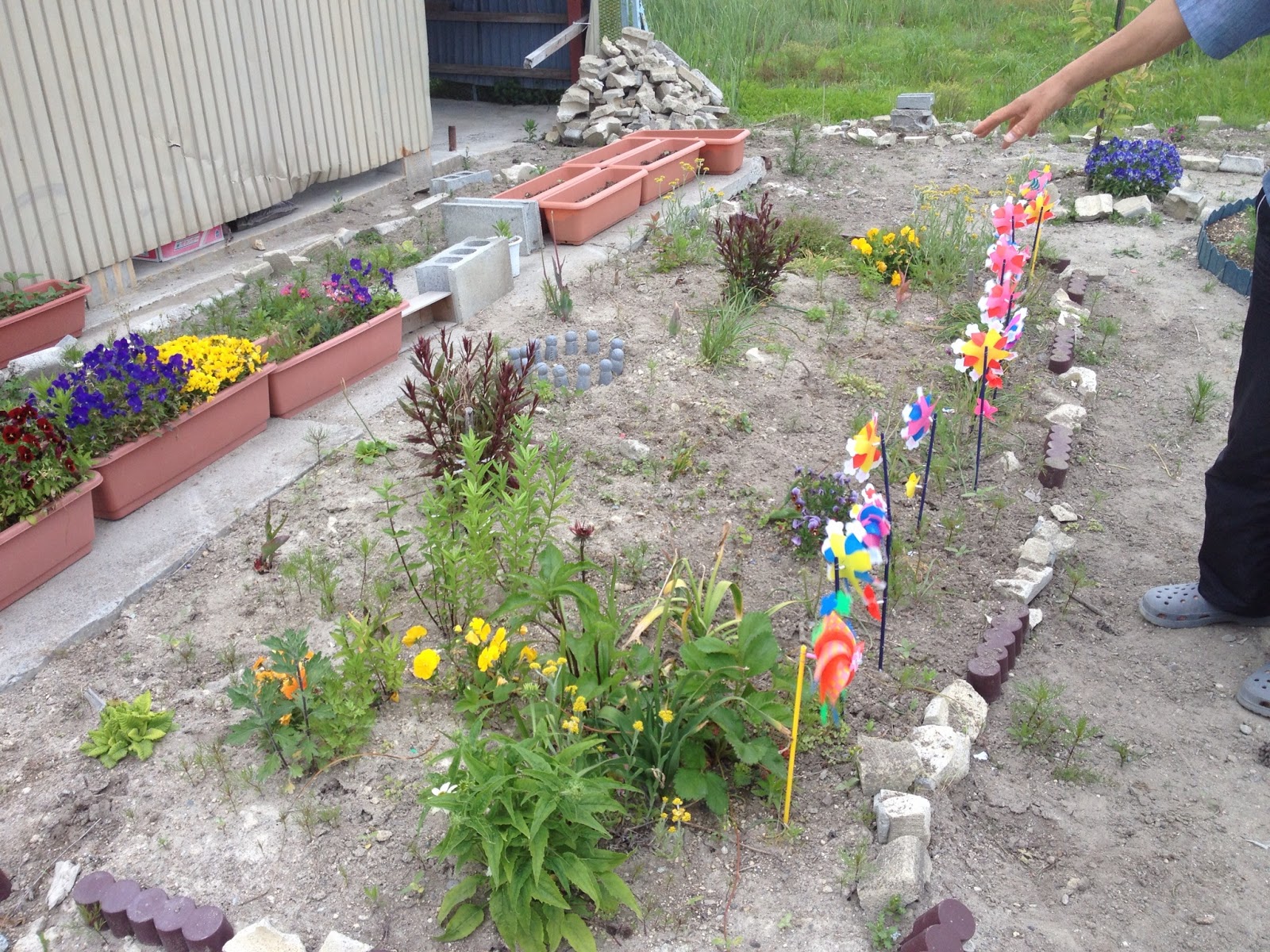
Pinwheels bear witness to the dead in a little memorial garden at the original Fuji Kindergarten site.
And Junko-sensei’s devotion seems to have crossed the boundary from death into new life. When the community weighed whether or not Fuji Kindergarten should continue on as an organization, people said they felt guided by Junko’s witness to give the sake of the surviving children highest priority. Fuji Kindergarten now gathers in a new building while the original building is kept as a memorial for tender, brave souls, still scarred by a death-dealing, imagination defying natural disaster. The entrance is now ordained with thousands of paper cranes, a visitor book, and flowers. A small memorial garden, tended each day by the principal, includes 13 pinwheels for the 11 children who died in the tsunami, Junko-sensei, and a student who died in a car accident a year after the quake. Junko-sensei’s husband was baptized three months after her death, and their four children carry the family legacy forward in faith.

On the way back to Sendai, Shintaro and I discussed the uncomfortable implications of preaching on Sunday’s readings in the context of such devastation. How could we preach on the raising up of the sons of the widows of Zarapheth and Nain when children known and loved today will not rise again in this life? Maybe the response of the Body of Christ to the Japan earthquake and tsunami provides at least a partial answer. The restoration of the sons of the widows restored their mothers to life in community, ensuring them connection and hope for the future. The Church in Shinchi and throughout Tohoku has been doing precisely that — restoring one person, one family at a time to community and hope for the future with the Issho ni Arukou Project:

It simply means “Let us walk together.”

Matsumoto-san shows the water line in a storage shed on the original Fuji Kindergarten property. Almost two-thirds of the student body were picked up by their parents between the earthquake and the arrival of the tsunami. The remainder were loaded into buses, but couldn’t pull away from the school before the water struck.
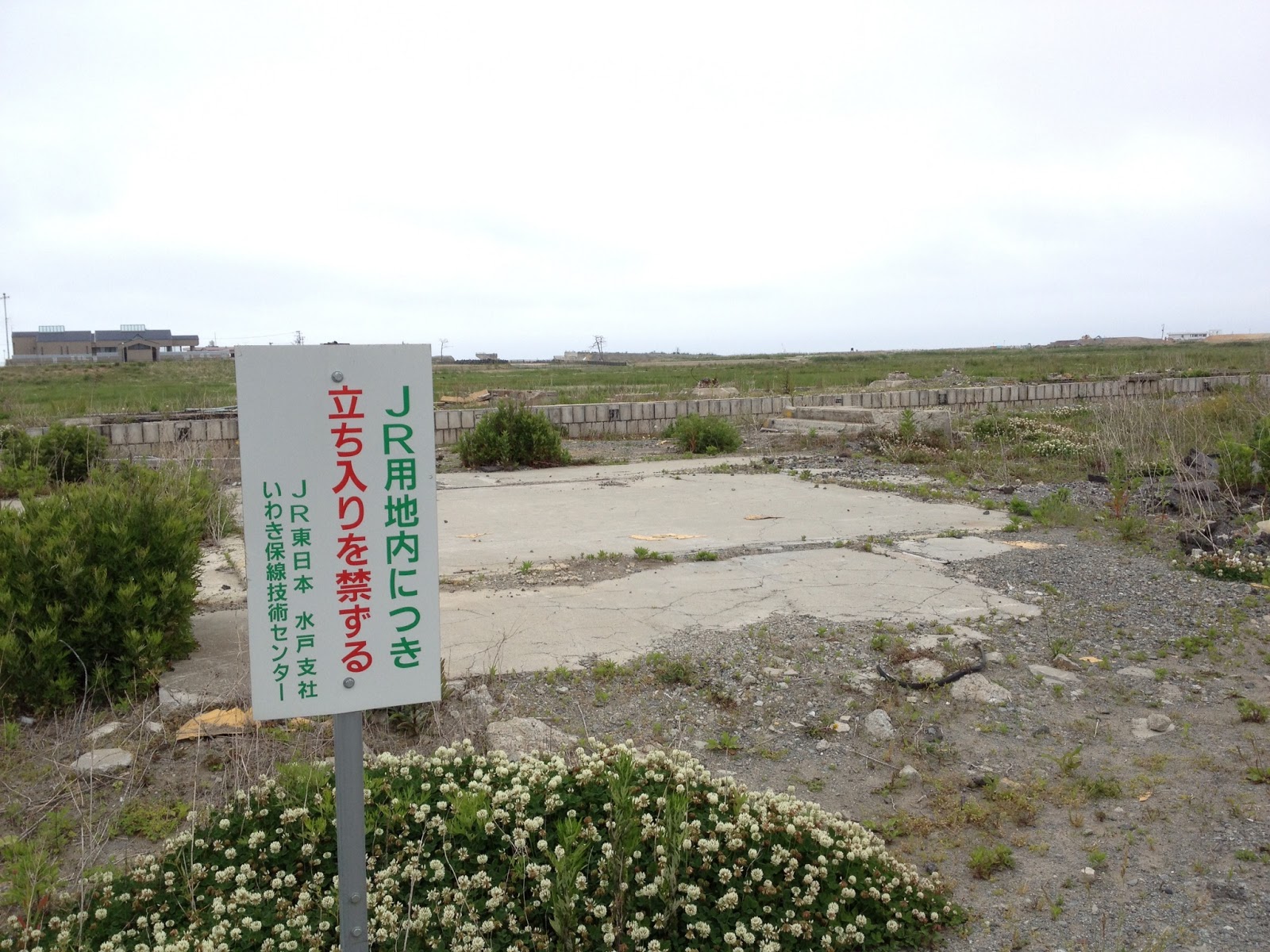
The remains of the Shinchi Japan Rail Station are marked only by a foundation and a no trespassing sign. The tsunami ripped up the rails, littered the landscape with train cars, and demolished the wooden terminal. A more robustly built water treatment plant in the background survived.
The view from the shrine overlooking the residential neighborhood wiped out by the tsunami. Residents who fled here watched the water reach almost to their feet before it receded.
Foundations are all that remain in this residential neighborhood. The concrete slab in the center of the photo is not a foundation, but a bridge that was lifted, flipped, and carried nearly a hundred meters from its crossing over a canal to the wharf.
With volunteers and residential staff of the Issho ni Arukou Project in Shinchi.
Our host, The Rev. Shintaro David Ichihara (L) and Daniel look on while Hiroshi Matsumoto shows before and after aerial pictures of Shinchi.


Tuesday, November 22, 2011

May We Not Lose Even One

I am reminded of a reading recently in the Daily Office, where Jesus, not unlike the Ghost of Christmas Present, points to a child as an example. In these days of political madness, widespread struggle, commercial frenzy, and holiday stress, his words are for me like balm to an open wound in our common body.

From a new article at Episcopal Café.

Sunday, September 21, 2008

An Unfair God

Sermon delivered at Church of Our Saviour, Mill Valley

Sunday, September 21st, 2008.

Proper 20 Readings

Well, this week the world changed, didn’t it? Over night the rules on stock trades tightened, an esteemed Wall Street institution disappeared, a huge international insurer was buttressed by the federal bank, and both presidential campaigns completely re-tooled their messages around that now old adage: “It’s the economy, stupid.” And after a week where some people woke up to find themselves without work, without pensions, or at least somewhere they didn’t expect to find themselves on the vast spectrum between lots and nothing. . . central banks worldwide
began coordinating their efforts, and our national leadership decided it was time for the government to work out a way to bail out the free markets to the tune of $700 billion. It’s a figure that seems too huge to me to imagine. Then the papers report that part of this will involve raising the national debt ceiling to $11.3 trillion, a truly staggering number indeed. I’ll stop there. Many of you know the story better than I.

So why bring up the greatest financial meltdown, some say, since the Great Depression, in a sermon on a sunny morning at Church of Our Saviour? Why talk about dollars, debt, and the economy at all in a liturgy all about God? Because, of course, first and foremost, some of our members live, work, and breathe in the world of numbers and finance. Some of our sisters and brothers have been hit by the unprecedented swings in the markets this week – and have lost. And all of us are uncertain about what happens next. And then, in comes today’s very strange parable about simple street economics, and I am left wondering just what is the connection between Wall Street, Main Street, and the Jesus’ imagined street where the workers are hanging out waiting for employment in the vineyard.

Over lunch this week, a colleague put it quite simply: It’s not fair. Period. We are rankled, some openly, others quietly inside, about CEO’s walking away from failed financial giants with tens of millions in golden parachutes while nameless employees of the same companies, good, hardworking people who have devoted decades to the institution, are left with valueless savings or pensions and nowhere to turn. We might be rankled, too, if we were in Jesus’ parable, first to show up to the vineyard but discovering at the end of the day we receive no more than those who arrived at 5 o’clock. And might not we be annoyed with the landowner, God even, who argues like any governing board or manager that we received what we agreed to – CEO or office assistant – along with all the risks, perks, and privileges. It’s not fair. And if Wall Street and the current mess in the nation’s economy punches a hole in good old-fashioned notions of American fairness, then so does today’s Gospel. Full stop.

In some ways, it’s even easier to cope with Wall Street’s unfairness. Risk, we could say, is part of the game we sign up for when we invest either ourselves, our capital, or both. But we didn’t really sign up to invest in God’s universe. . . we simply are here. So if God is just as unfair, maybe we have even a greater cause to complain. At the heart of our theological angst is the same fear at the heart of the greater world’s angst this week: that bad things happen to good people, and rarely do we receive what we expect, what we consider fair. The world, the universe, and even God’s way of being among us seems much of the time unpredictable and capricious. In the kingdom of God, Jesus says, the last will be first and the first will be last. There doesn’t seem much wiggle room for proclaiming “not fair!” and no cosmic or heavenly SEC, federal regulatory commission, congressional hearing, or even a Supreme Court to adjudicate the final decision. Now, who wants a God like that? Arbitrary, it seems, and unable to connect with our notions of fairness to the point that our faith in a greater power who loves us might be profoundly shaken.
The deeper challenge that I hear Jesus posing for us his followers, as well as his earliest disciples, is that our notions of fairness often mask our desire to get ahead. And get ahead on entirely the wrong terms and over the wrong things. My inner dialogue often goes something like this: if only the playing field were really level, I could get ahead. Why? Well, because I’m smarter, tougher, and more resilient than a lot of other people. I show up early and I stay late. I take on more. I work harder.  

Leveling the playing field, a lot of the time, is really about leveling the playing field for me. Fairness is fair only when it gives me an edge, an advantage. So I can show up to the vineyard early and get one of the better-endowed contracts. That’s what the landowner means in a profound way in today’s parable when he questions the fairness argument; when he asks those who are grumbling because they came early; when he asks them quite simply if they did not receive what they agreed to. They really want to be ahead of those loafers who came late. Because they believe they deserve it more. Today’s parable is a stinging indictment of our very human proclivity to justify ourselves, to believe ourselves to be more righteous, more deserving than others, to see ourselves at the front of the line when it comes to God’s grace. And one way we do that is by declaring “it ain’t fair.” Barbara Brown Taylor puts it this way:

[Today’s parable] sounds quite different from the end of the line, after all, than it does from the front of the line, but isn’t it interesting that 99 percent of us hear it from front row seats? We are the ones who have gotten the short end of the stick; we are the ones who have been gypped. We are the ones who have gotten up early and worked hard and stayed late and all for what? So that some backward householder can come along and start at the wrong end of the line, treating us just like the ne’er do wells who do not even get dressed until noon!

So does that archetypal CEO with the $20 million deserve what he gets any more than his co-worker elsewhere in the company who lost everything? The world’s answer might be yes and it might be no, or it might wash its hands of the matter and call it capitalism or the risks and rewards of the marketplace. Maybe we could delve deep into the personal history of each person and the string of choices that led one to the top of the corporate ladder and the other one into a more obscure, less financially secure position. Or we might push it back a layer and talk about their education, or their opportunities growing up, or their parents’ examples. How far back would we go? Where would we stop? But maybe, given today’s Gospel, we’re asking the wrong questions.

It might be more true, Jesus argues to us out of today’s parable, to recognize that we all came into this life with nothing, and we leave it with nothing. . . save, of course, the real wage that God has promised. And to understand that wage, look at what happens, my sisters and brothers, when we come to the altar for Eucharist. Each of us, no matter where we appear on the socio-economic spectrum; whether we won, lost, or drew even this week; whether we work hard or enjoy leisure more; whether we deserve it or not; even whether we’ve been good or bad or indifferent. . . each of us approaches the altar and receives exactly the same wage: the bread and the wine, the body and blood of Christ crucified and risen for us. For that is where our true identity resides. Not in our portfolios or positions. Not in the stature of our work or our status in community. Trust me, don’t let the nice clothes, the snazzy titles, or the high pulpit fool you. The last will be first and the first will be last. It’s the world that measures in terms of economic prowess and political power. God’s realm looks at human value and identity through a radically different lens than do we much of the time.

Paul’s Letter to the church in Philippi caps today’s Gospel message with this little tidbit: neither our life, nor our death, is as important as Christ’s life in us. Full stop. It’s that resurrected life in Christ that can help us turn to one another in these tumultuous times and hold each other up. Christ’s life in us can lead us out into a world that is struggling and suffering in the present chaos. . .lead us out into it with renewed purpose, where we live no longer for ourselves, but for God’s Creation, God’s People, and a world in need of hope. A purpose that transcends Wall Street and Main Street, and lives wherever compassion renews our humanity; leaving behind the fairness argument and instead working for justice: and that is whatever restores relationship, human dignity, and community. And in doing so, that life in Christ guides us and nourishes us through the uncharted wilderness and leads us, together, towards the Promised Land.


Quotation from “Beginning at the End” in The Seeds of Heaven: Sermons from the Episcopal Series of the Protestant Radio Hour by Barbara Brown Taylor (Forward Movement Publications, 1990).