Showing posts with label theology. Show all posts

Saturday, April 22, 2017

Easter Saturday / Earth Day

“God saw everything that he had made, and indeed, it was very good.” - Genesis 1:31

Someone once challenged me to justify Christian ecological concern using scripture. We need look no further than the first chapter of Genesis. Who are we to damage and destroy what God has deemed good?

God has woven an Easter hope into the very fabric of life itself. The biosphere, like our bodies, has an astonishing capacity to heal. And like us, an astonishing capacity to rise again to new life.

Our destruction of the natural world is a reflection of our sinful insistence on living in a Good Friday universe, where we crucify Life itself in the name of our own fear, our craven desire for power, and our boundless capacity for self-destruction.

But Christ rises from death and appears in the garden. Mary Magdalene mistakes him for the gardener, but perhaps this isn’t a mistake at all, but a reminder that the Maker of the Garden rises again in the context of creation, in the midst of the vibrant springing forth of all life season by season, year by year, epoch by epoch.

Too many Christians have mistaken scientists as the enemies of faith, but what we have failed to comprehend is that so many are the observers of the goodness of Creation, the recorders of the wonder that -- as we Christians might put it -- God began and Christ continues to redeem.

Science as a discipline has its roots in the Christian academy: the university. Part of being an Easter people is about healing the false rift between science and religion, and remembering that what God has made -- and what God is prepared to raise to new life if we will only allow -- is indeed very good.

Thursday, April 20, 2017

Easter Thursday vs. Emotional Narcissism

Do you believe?

This unnerving question haunts the Easter community of Christ. But too often, we hear it as a demand to offer intellectual assent to the implausible or, perhaps even worse, an expectation that we must feel a certain way before we can judge ourselves faithful. Both are paltry versions of belief that don’t get us very far.

What happens as the Easter glow fades and the Great Fifty Days are still before us? When the zeal of the newly converted wears thin? When the honeymoon is over?

Thomas continues to ask questions. Mary Magdalene’s witness falls on incredulous ears. The first apostles wonder what to do next and sometimes gather in fear. Even when directly confronted by the Risen Christ, Peter is bewildered and unsure.


But belief is not overruled by doubt, fear, or confusion.


As for the first apostles, so it is for us:


Believing is about choosing to remain in relationship.
It is about the hard path of learning to trust.
It is about the discipline of showing up.


Who knows how we will feel today or tomorrow?


But for God in Christ, all that is secondary. What matters is that we choose to be an Easter people. Mary Magdalene persists in delivering her message. The apostles continue to gather, in fear or not. Peter answers the call and puts one foot in front of the other.


That is what believing is about.

Tuesday, April 18, 2017

Easter Tuesday vs. the Arrogance of Caesar

Even after defeating death itself, Christ does not rule like an earthly emperor or king. He greets his followers in hidden rooms and seeks them out in fearful places. He walks with them along the road. He dines with them on simple fish by the lakeshore. He is not troubled by our lack of recognition or ill-tempered at our ignorance and timid faith. He only asks, “Do you love me?” and, if we do, he commands us only to feed and care for one another.
The rulers of this world posture, bluster, don cloaks of violence, and send forth great armies, concealing their incompetence with a veneer of arrogance. Compassion is always secondary to the laws of fearful statecraft, and humanity and the natural world are commodified and expendible in the economy of the anti-Christ.
Despite all this, the Ruler of the Universe who died for us rises to new life and lives among us and in and through us with a disarming humility.
For all the shameful ways the world marginalizes, we are not alone.
And we never will be again.


Monday, April 17, 2017

Easter Monday vs. Dreams of the Dead

What a fascinating, terrifying age we live in, where little boys who never grew up sit astride apocalyptic powers, trying to live into the death-dealing dreams of their grandfathers, and millions of lives hang in the balance.
This is the culture of death writ large in a world crafted by the long-deceased. The dead teach and lead the dead.
But we resist the Culture of Death. God’s radical hope is not waiting around for us to grow up. The New Life has already arisen and walks and lives among us, calling us forth from the tombs, as the old song goes.
This is the paradox of Easter:
Life renewed in the face of the Culture of Death.
Courage, my sisters and brothers.


Tuesday, December 13, 2016

God of Shadows

A Reflection for the Quiet Days of Advent
The Bishop’s Ranch
Healdsburg, California

This is a very strange Advent. And that, I suppose, is saying something for a season that is meant to be strange. Talk of angels appearing to virgin peasants, wild men shouting at crowds in the desert, and the strange intersection of prophecy, worldly power, and divine favor have always made Advent an odd season, filled with paradoxes and contradictions.

But this one seems especially odd with a body politic turned on its head and things I grew up assuming and trusting no longer reliable. This Advent feels like someone turned out the light of enlightenment and odd shadows are thrown this way and that as one person’s rising star becomes another’s heart of darkness.

Serving a largely politically liberal community has met me with unexpected questions that I could have scarcely imagined even a year ago. What does it mean, for instance, to pray for our our new government-elect? What do we ask for? What do we pray for when it comes to the world’s fiefdoms and principalities and powers changing hands in ways we did not expect, and in ways that many of us didn’t want? What does it mean when we pray (as we do in my parish) for our new administration-elect to be granted wisdom and compassion? What do we legitimize or de-legitimize with such a prayer?

Which takes us to an even more ancient question of faith: Do we only pray for what we want or desire? Do we only praise God when we deem something that happens is good? And do we pray for things to change only when something is unfolding that we deem harmful or bad? Do we face the darkness only praying for the light? Do we ask for darkness to fall on those whom we deem benighted, and light and gracious power on those we deem enlightened?

Our fundamental bias is that we often believe that ours is the God only of daybreak, of light, of illumination. Something or someone else commands the darkness and shadow. And so we, like the ancient Greeks and some of our early Christian ancestors, imagine or at least pray as though the world is divided up spiritually and even materially into light and dark, daybreak and shadow, good and evil.

The womb is also a place of shadows, and we all began our lives in the dark. Our habit is often to romanticize the womb as a place of loving warmth, and for all of us blessed with loving mothers, it can certainly be that. But the womb also contains the seas and storms of billions of years of evolution, of cells organizing over and against chaos, of marking the boundaries between the energy of life and the dissolution of death, between child and mother, between this life, that life, and not life. It is about the infinitely complex dance of genes, chance, and circumstance mysteriously created by and infused with a Spirit who knew us even before we were conceived. It is about the death of billions before us that taught our bodies and minds how to survive, develop, and grow for a brief time in this world. And even then, it is simple biology but hard for us emotionally that over two thirds of attempted starts on this journey fail. So our very being knew death, chance, and vulnerability from the very moment of conception. To the very essence of every cell, we learned death before life, we knew the shadows before we saw the light.

That God risked everything to emerge into our world through this dangerous, unpredictable, and astonishingly miraculous process is in itself a testimony that ours is the God of shadows, a God who knows death and the role it plays in our development and the unfolding of our universe. And ours is a God who knows daybreak in the darkness, and the shadows that come with the light.

It is only our very deep Greek and Eastern cultural and philosophical influences that often bifurcate a reality of life and death, light and shadow, death and life. But to God, all of this – including the light and the shadow – just like energy and matter, space and time — are made of the same unnamed, mysterious  stuff, part of the same process, part of the inextricably intertwined pattern of Creation. It is not enough to blithely say – as we sometimes do – that without darkness there can be no light, and without daybreak there can be no shadow. It is more accurate to say that God is the God of both, and there is a deeper reality in which both are one.

And that deeper reality is one that only God knows and understands.

So God is God, too, of our odd political moment. Which I suppose is not very odd in the grand scheme of things. Jesus was conceived and born in a world of odd political moments in his own time, and the quest for power and intrigue was already as old then as the tradition of prophets and kings, of powers and principalities, of despots, of empires.

God is God, too, of our shadows. Of our failings and of our blindnesses. Of those benighted parts of our souls scurrying for cover to nurse their neuroses or those parts of us yearning for the light. God is there, too, ever at work — an understanding both comforting and unsettling, paradoxical, and yet very much made to order for Advent.

The message of the incarnation that we lift up — as the shadows are long, the days are short, and daybreak comes late — is that God is the God of all of us, divided souls and communities, of diverse and conflicted peoples, God of a world teetering ever on uncertainty. Ours is a God who meets us in death as well as in life, a God who understands both the birth of stars and the vast darkness between them, a God who sees the death of every part of us making way for the new, who knows the fullness of not only our life, but our death as organisms, the deaths even of our very thoughts, the loss of memory, the dissolution of reason itself… and all their redemption and more.

As the mystic Psalmist has written:
Darkness is not dark to you;
the night is as bright as the day; 
darkness and light to you are both alike. (139:11)

An Advent practice then is to learn how to pray in the darkness, in the shadow, in the land of uncertainty and fear, in the creeping doubts and inchoate worries. For God dwells there, too, and God — always — has the last word.


Thursday, December 17, 2015

Stirring in the Darkness

“Who then shall stir in this darkness, prepare for joy in the winter night?”
- Carol Christopher Drake

It is difficult not to feel this year that wider society has entered a collective winter night of the soul. We have gone rigid with fear in the wake of terrorism and in the midst of a campaign season that can find no bottom to lows in public discourse. Ghosts of nightmares stir in the swirling chill, old memories of history recent past but seemingly long forgotten: the cold of bigotry, willful ignorance, open deceit. No one seems to listen anymore. It is just assertions shouted over the voices of everyone else. Those who shout the loudest win. We are sorted, but not into goats and sheep with the care of simple husbandry. Instead we are sifted ham-fistedly into winners and losers with winner-take-all.

Who then shall stir in this darkness? Who would want to? And where can we find joy when the shadows grow so long and the chill seems unusually cold this year?

Anxiety has always been a part of our condition. It must have been, too, in the air and water and the chill of the winter night all those years ago in Judea and Galilee, when Herod danced with his puppet masters and Roman soldiers watched with suspicion as the people eked out a barebones living. What chills must Mary have felt when all that stood between her and certain ruin were the words of an angel and the dream of her betrothed. And even then the darkness was certain: This new life stirring in her womb was sure to be trouble. Herod would brook no rival, and Rome would tolerate no challenge to the status quo.

To imagine God stirring in the darkness of her womb must have been as terrifying as it was thrilling and dangerous. To be a peasant from a small town few knew bearing a promise that was too hopeful for so many, too hopeful to be more than whispered about in close company… Well, who could possibly imagine any of it? And yet it inspired Mary to speak of a world where winners are losers and losers winners. Maybe she was turned so upside down with this stirring in the darkness, she could not help but see it invite the utter overturn of the world about her.

Who do we imagine might stir in our darkness of today, and dare we imagine anyone or anything stir in the dark in this age of cynical doubt, of narrow materialism, of perpetual war and angst? Is the Virgin’s womb barren in our time, so much so that we must shut our borders and cast suspicion within? So much so that we ignore the plight of teeming refugees, of a world run mad with suffering?  So barren that we must be convinced that the gracious years are gone and now we are to grasp in the dark, scrambling over each other for only scraps in the waning days of empire?

We want strongmen to arise and lead us out of the dark. But we who pause and reflect long enough remember in our bones that strongmen are only part of the darkness themselves. They brood, posture, and bellow like Tolkien’s dragons. They threaten and menace with power and its seductive promises. They cast about for enemies and blame, point fingers, and count might and perhaps count the heads of those who oppose them for a coming purge. This is not the stirring of a baby as it quickens in the womb, with innocence and hope. This is only the stirring of the old games of war, politics, states, wealth, and domination.

Who then shall stir in this darkness and prepare, prepare for a joy that is too wonderful to imagine and too subversive to be disclosed? Where would Herod and Rome be if suddenly their military might and posturing was shown to be only a cruel illusion, a self-perpetuating myth? What if the hope were so great that fear no longer roiled our body politic and people turned away from desiring the power to cast death and instead turned to offering only life and love? Terror would then have no claim on us, no haven in our hearts anymore.

But this is precisely the promise of Advent: someone stirring in the darkness, preparing for a joy even in the depths of a world’s winter. John the Baptist was not out to overthrow empire or even the king who wanted the prophet dead. No, someone was stirring in the darkness, he said, someone who would change everything. And change it forever. He had met that someone only once, and even then, it had been while in the darkness of his own mother’s womb. That Someone had come close enough to be felt yet unseen, perceived in ways that were beyond sight or sound or explanation. And in that moment, John had leapt for joy and made his mother cry out with wonder. And so now, too, a grown man stands in the Jordan, peering into the darkness of his people, looking for that Someone stirring yet again.

The prophet peers into each of us, looking for that Someone stirring in the wombs of our hearts, stirring in our relationships, even stirring in that poisonous place we call the body politic: stirring in the darkness of this winter night and every night; quickening, and waiting to be born, to birth joy into our midst, with light, with hope, with love.

Richard Edward Helmer, BSG

A reflection for the Silent Days of Advent
The Bishop’s Ranch, Healdsburg, California
December 17, 2015


Thursday, December 18, 2014

Vexed by the Journey

Little vexed me more as an aspiring, struggling pianist many years ago than a trusted friend — also a musician — telling me to learn to “enjoy the journey.” It’s taken me nearly twenty years to even begin to grasp what he meant, noting my temptation towards quick fixes, thinking more often about arrivals, and craving a predictable stability in daily life that is worse than unachievable. It is entirely unrealistic. Worst of all, it is just another pet idol of mine.

Which brings me, of course, to the institutional church, from which we all benefit as we sit here this morning in the beautiful confines of St. George’s Chapel at the Bishop’s Ranch, bathed in a most blessed rain slowly eroding a long drought. How on earth — building on millennia of tradition with roots in Benedictine and desert spirituality along with Roman bean-counting governance and parochial proclivities — did we get the idea that Christianity should be institutional? At the very best, I suppose, we might say we need a vessel — and we might imagine that in the naval sense of the word — to help us sustain our essential needs while we attend to the inevitable spiritual journey of the inner and relational life. But I, as a parish priest and veritable church governance junkie, encounter too often the severe limitations of institutional Christianity, and I cannot quite convince myself.

This time of year, we remember a young woman, probably barely into her teens, literally bearing Christ not in the comfort of her own home in Nazareth with supportive, familiar faces and hands tending to her, but somewhere on the road outside of Bethlehem, in the midst of strangers. According to Luke’s account, at least, as a Galilean Jew, she had entered the somewhat foreign and hostile domain of her ancestral Judea with her betrothed, knowing full well she would bear her child, begotten under most dubious circumstances, while en route. I can only imagine what my wife might have said to me, in those interminable weeks leading up to the birth of one of our children, had I told her we were going on a long journey, and we would not be home before labor. There are probably more than a few suitable Japanese expressions for husbands spouting clueless ideas!

Yet Mary, the Godbearer, almost never has any significant interaction with Jesus in the gospels unless they are somewhere other than home. There is that precious glimpse of Jesus’ teenage years while on pilgrimage to Jerusalem, where he incurs Mary’s fury for worrying her when he lingers behind in the Temple. There is that argument in a kitchen in Capernaum over a wedding party running out of wine. And there is, of course, that image of Mary with her suffering son about as far from home as they might imagine ever being: on a hill called Golgotha.

“Madonna of the Bamboo Grove” from Four Japanese Madonnas, an online collection curated by The University of Dayton
Mary has been called the first Christian, and I suppose it is not just for her willingness to physically bear the Son of God. It is for her willingness to journey with him into the strange, unexpected, and even terrifying; carrying him at times even into the loneliness of a stable with only the company of a somewhat mystified but stalwart Joseph and a handful of stinky animals and shepherds; or receiving her son’s body in that most poignant station of death on Good Friday.

Our predilection to reify Mary may at times obscure her witness to what it means to be truly Christian. It is not simply a matter of sitting in comfort, as we can this time of year, and sing Veni Emmanuel, unless we mean it like an expectant mother in the midst of labor. Nor is it simply a matter of hanging out for the Second Coming in the beauty of our institutional churches, unless we expect that coming to mean not one beloved stone being left upon another. The only stability we are meant to cultivate is that radical trust in the promises of God. Institutions, comforts, and even homes come and go. They can be as fleeting as a long-practiced piece of music, the fading tones of a performance, or the echoes of applause.

The Christian life is like Mary’s, after all, uncomfortable and dusty on the road, with no room at the Inn and unexpected meetings with total strangers, and the comforts and faces of home only a wistful memory. Our idolatry of stability, of sitting comfortably on the laurels of our accomplishments and conquests, explains a great many things wrong with our civilization today and across the ages. Journeys are powerfully vulnerable moments in our lives, but also the most profoundly real as we are exposed to the elements and uncertainties of a capricious universe. And so it is there that Christ comes – sometimes to us, but more often because we carry him and give birth to him there. It is there we also vent our fury at his mystifying talk about God and something he calls a kingdom. We, too, are vexed by his wandering ways and upside-down teachings. . . and we sometimes find ourselves receiving his body after the world has had its way with him and our journey — along with his — seems to have reached an abrupt end.

I suppose my greatest struggle with music and journeys all those years ago was with the “dirty laundry” of missed notes and frustratingly difficult passages and the lonely hours trying to master an instrument, a phrase, a chord, and, above all, myself. The truth of my friend’s counsel was that there was no short-circuiting, no circumventing that process. And then my even harder learning was to value that long journey when at last I would push a piece out in front of an audience, knowing even then that it might fail or I might fall to pieces in a pile of nerves. But that, too, is the journey of the true Gospel, the true Church, and all of us when we are sometimes approaching what we might call true Christianity. No amount of institutional comfort can save us from the journey we must undertake in this pregnant time. No amount of bean counting and careful preparation can forestall or circumvent the dangerous, uncertain, and sometimes seemingly endless labor of pushing Christ out into the world.

But as vexing as that is at times, it is our calling. And we, like Mary, undertake the journey risking a radical faith in the whispers of angels and the ephemera of dreams. I still take no comfort in clichés like “the journey is the destination.” But then, who said I am to be comfortable? This late in Advent is an ironic call to discomfort (“Comfort, comfort ye my people”), because nothing new comes without upsetting the old and the known, and until we learn to leave our idols at home and carry the living God with us on the road of life, we will not know our salvation.

Monday, April 21, 2014

Easter Incongruity

Sermon notes for Easter, 2014.

Nearly fifteen years ago this autumn, my wife and I both arrived in the Bay Area within weeks of each other from two very different parts of the world. But it didn’t matter if you came from western Japan or the American heartland: the Bay Area was just as expensive and roiling with newcomers scrambling all over each other to get it while the getting was good. Some of you will remember the dot com bubble, and perhaps some of you, like me, find our current milieu eerily similar.

It seems we live again in a familiarly cynical, self-absorbed time. Business-as-usual involves 101 turning into a parking lot twice a day, sky-rocketing housing prices, old neighborhoods being rapidly gentrified by bidding wars, and an almost palpable feeling that you’d better get yours while the getting’s good.

It always strikes me during Holy Week and into Easter how incongruous, how out-of-step our observance of these high holiest days of the Christian year appear against the backdrop of Southern Marin and the wider Bay Area. And this year felt conspicuously incongruous, as stopping for time only to think about where we are headed and why might just lose us the race. Even more would stopping from business-as-usual long enough to think about a God who dared to risk everything for us – even death on a cross.

To paraphrase another passage of Christian scripture, the cross is foolishness to the world. Resurrection more so. A society of winners and losers depends on the certainty of death and a kind of inevitability for the victors. That is how the world is built and maintained. Even if we don’t always see it, we feel it in our exhaustion and uneasiness with the present time and how it distracts us from the warmth and beauty of a spring day, or the scents of the flowers, or dulls and anesthetizes us from the pain and wonder of those priceless gifts the world has not yet invented a way to commoditize: love, generosity, and compassion.

And yet we are here. Like Jesus’ first disciples at the tomb.

Those first followers gathered at Jesus’ tomb must have also felt – to the core of their being – the sudden incongruity of their lives with business-as-usual. Business-as-usual meant the Sabbath in Jerusalem was over, and much of the population was back at work for a new week. The religious authorities were poring over their latest dust-up with a charismatic pretender who had threatened both their tightly held traditions and their fragile economic/political agreement with the Roman occupation. But fragile as it was, they had come to rely on it for their prestige and power. And with the death of Jesus and the dispersion of his followers, that fragile alliance would hold. Pilate, governor of the occupation, and the garrisons under him had just executed another criminal and rabble-rouser: probably one of many during his tenure. Crucifixion was always a handy way to frighten and shame the locals into line and get rid of threats to the Pax Romana at the same time. So the tribute to Rome from this dusty, irascible, little country in the backwaters of empire would keep flowing for the foreseeable future. The Roman occupation could start a new week resting on its laurels that the drama of the weekend was satisfactorily resolved. They had done their jobs, and business could go on as usual.

But not so for the disciples at the tomb. They had planted their lives in a different garden, in an economic and sociological dead-end, a graveyard far outside the halls of power – about as far away as you could get. Jesus had taught them not to base their lives, their essence and hearts, on the rat race as they had known it. And much good that did them. Now they were far beyond the reach of the comfort of business-as-usual, stuck with a dead teacher, prophet, rabbi, and friend. And who needs a dead Messiah? They didn’t. And even if they had the imagination and savvy to turn him into a political martyr, his closest supporters and friends were scattered in fear, with no political alliances to leverage with any effect. In the tomb with Jesus was the dead barest beginnings of a revolution called “the kingdom of God.” The kingdoms of the world had defeated the Jesus revolution, cutting it down even before it had a chance to fully take root, crushing it under the heel of human empire, the well-practiced art of manipulating the mob, and the weighty, inevitable structures of economic and military hegemony.

And so imagine their surprise when they find the tomb empty, the stone rolled away!

When Mary Magdalene encounters the Risen Christ, how can she but mistake him as the gardener? That would be business-as-usual: the only expected stranger we might encounter in the company of the tombs and the dead.

It will take her, and Jesus’ other followers, a moment—or more than a few – for them to perceive the Risen Christ. And it will take a whole community to help us realize what the resurrection means…

God in the Risen Christ tells us it will no longer be business-as-usual. Something fundamental has changed, and God has broken into the world, rolling away the stones of tombs and ushering new life for the dead. The race the world offers is unmasked and emptied of its power over us. We are offered a different kind of life: one not rooted in fear, death, and competition of a cynical and self-absorbed age. Instead we are offered a life that conquers fear and death with abiding compassion, love for others, and unimaginable grace. So the question for us this Easter, then, is this:

Will we decide to continue business-as-usual? Or will we look where the women of the Gospel looked: into the margins, the graveyards, the dead ends of our lives and souls and those of others? Perhaps the incongruity of the broken bread and the common cup will awaken us this Easter to discover Christ rising to new life, the Jesus revolution arising again among us. Perhaps we will uncover our calling again as Christians to “turn the whole world upside down” in ways the world cannot understand, recognize, nor ably oppose.

The weapons of the Jesus revolution, after all, are not fear, guns and steel; nor are they venture capital, hedge funds, and technological innovation.  They are instead compassion, generosity, forbearance, forgiveness, and that wild peace in the face of death that resurrection engenders: a peace that signals our freedom from the final tool the world employs against us, death itself. And these priceless Easter virtues are here for the taking. Will you take them up again?


We remember today this promise: we are first and foremost an Easter people. This world will pass away, just as did the Roman Empire and many kingdoms since. Jesus lives forever. And so, then, might our truest selves born anew in him: our Easter selves, fresh as the spring, fragrant as the flowers, powerful as the seasons, and given as new life for everyone.


Friday, April 18, 2014

The Good Friday Project

Sermon Notes Good Friday, 2014

Good Fridays were always busy for my family. As a high schooler, I remember hearing the passion according to John’s gospel in our little mission church, and then driving up the road from McPherson, Kansas, to Lindsborg, where my parents and I would play in the annual performance of Bach’s St. Matthew Passion. It was, at one level, my first acquaintance with the distinctions between two biblical renditions of the passion narrative. It was, at another level, finding a way to really begin to grapple with the texts at the very heart of our religious tradition. As a youth, Bach’s musical treatment of the passion always moved me, as he would capture the emotion of each verse and repeat it in glorious counterpoint passing between orchestral sections and the double choir. . . until its meaning sank into the very depths of the soul. It was, you might say, a striking example of eighteenth-century lectio divina.

I remember my first Good Friday without playing in Bach’s St. Matthew Passion as a capstone, and how empty I felt without it. Recovering a sense of deep engagement with the passion narrative then became part of my struggle to grow up spiritually, to grow up in faith.

Richard Rohr argues, “All healthy religion shows you what to do with your pain. . . Great religion shows you what to do with the absurd, the tragic, the nonsensical, the unjust.”

Good Friday is precisely about all these things, and no amount of theology seems to get us beyond the absurd, tragic, the nonsensical, and the unjust nature of the passion. And yet, it is tempting as we have often done in the Western Church: to simply project all of that onto Jesus, call it redemptive, and then go home. But that, we all learn sooner or later, is not enough.

One of the great steps in my own journey was to reflect in recent years with my spiritual director on my own pain and suffering. At a critical point in that conversation, I finally said out loud – with more than a little trepidation after years of ordained ministry – that I had learned my pain and suffering were nothing compared with others’.

“Yes,” he replied, “but it is still your suffering and pain.” No one else’s. Just as much in need of redemption as anyone else’s. And no amount of undertaking the odious task of comparing my suffering with others’, or denying it, or looking for the right pill – spiritual or otherwise – to take it all away would accomplish that.

Until we are ready and willing to see the cross as God’s identification with our own suffering, individual and shared, we will not get past treating Jesus as only a mere scapegoat, only a cosmic carrier of our sins. Jesus’ suffering, much as we often misapprehend our own prayers and theology, is not a simple substitute for ours. Good Friday always ran the risk of turning into an abstraction for me: the next step in completing a theological formula that would perhaps end all my heartache and pain. But reality ultimately confronts and challenges our abstract notions about salvation. Most of us learn through the trials of experience that no matter how much we focus on Jesus’ suffering or think about it, it doesn’t take away our own. I often wonder if this isn’t an unspoken reason that many people leave the church or abandon Christianity all together. At our worst moments, the Church has sometimes behaved no better than snake oil salesmen, promising relief if you buy the mythical magic formula.

But we must learn that Jesus’ suffering is not some great cosmic talisman to ward off our pain. And the Church is not a simple pharmacy where we pick up our medicine and then go home and follow the prescription.

No, Christ’s suffering faces and transforms ours. In the old language, his redeems ours. His takes on the absurdity, tragedy, nonsense, and the injustice of our lives and makes it – sometimes with great endurance and sweat – all something holy. Through the cross, he takes the awful pain and messiness of this life and infuses it with meaning, purpose, and transformational power. And if we let the cross do this work in our lives, it not only transforms us, but turns us into true Christians, ready to help transform the pain and suffering of others. That is what we might call the project of Good Friday – a project that begins with Jesus, and into which each of us is called. We have been, of course, very much like the disciples, running away in fear and denial. And yet the cross remains: our invitation to become part of the mighty salvific act that God is offering all of humanity in Christ.

As a healthy religion, our tradition of the cross encourages us to offer our pain to God. Sometimes it will be relieved. Sometimes it will remain. But either way, the promise is that it will be transformed into grace for us. As a great religion, our tradition of the cross offers us a pathway to transform the suffering of others as well. Sometimes we will be able to relieve that suffering. Sometimes we will not. But either way, the cross calls us into the transformative acts of compassion that end the loneliness that suffering engenders. We then carry it together, lightening the load for one another. And God in Christ carries all of us together.
In that way, we see that our suffering is shared, and ultimately made holy. In that, we partake in God’s sharing with us in Christ, broken in the bread, poured out in the common cup. All that has blighted our life, then, is re-purposed for redemption. Our suffering is like Jesus’, and his like ours: offered out of love rather than resisted or denied in fear. And our life, like Jesus’, becomes an offering poured out for all the needs of others.


Recovering a deep engagement with the passion narratives for me began with recovering a fuller sense of my own pain and suffering, my need to see that redeemed, and my choosing to actively participate in that redemption. And that is where we all begin again together on Good Friday: at the cross, with the suffering of Christ identifying with our own, remembering our place on the cross with him, and seeing in his eyes our own reflected back. . . and through them, a God who loves us so earnestly that no part of us is beyond the renewing, life-giving touch of the divine.


Saturday, April 05, 2014

Stubborn Salvation

Sermon Notes for the Fifth Sunday in Lent, Year A

Readings

Most of us gingerly dip our toes in the waters of faith through hope. I hope there is more than this life. I hope the virtues like love and fidelity are worth it. I hope death is not the end. Hope is given as a Christian virtue, of course, but I find it somewhat remarkable that I can’t come up with a single verse in any of the gospels that Jesus commands us to hope. It’s only a word that appears in his absence or expected presence.

And so we come to another of the great “I am” statements in John this day – John’s rewriting of the familiar and ancient Torah, beginning with the creation narrative, disclosing as he did to us last week that by working in Jesus, God has not yet arrived at the seventh day sabbath rest… and this day recounting another play on the “I am” of the burning bush, the divine disclosure of being both primordial and eternal, both transcendent and imminent, both wholly other and fully present.

The focus is on the stinking tomb of Lazarus, that festering wasteland of death that haunts so many of our worst fears and wrecked dreams. John does not hesitate to ladle every possible oppositional force into the story, reminding us that Christ, the Word of God’s great “I am…” is up against every conceivable human obstacle.

On discussing making the journey to Judea, the disciples are rightly worried their teacher is walking into the inevitable, deadly trap of the religious and Roman authorities in the Jerusalem orbit. Thomas, ever the realist bordering on cynicism, offers resigning snark worthy of twenty-first century:

“Let us also go, that we may die with him.”

John must want us to feel the inevitability in this story we all feel about the finalities of this life, the surrender to forces beyond our control, the undeniable reality of our suffering and the press of death.

Mary is too grief-stricken to greet her friend and savior. Martha, the more pragmatic of the two sisters meets Jesus with a thinly veiled accusation:

“Lord, if you had been here, my brother would not have died…”

followed by a thin sliver of hope:

“But even now I know that God will give you whatever you ask of him.”

But when Jesus offers unwavering assurance that her brother will rise again, Martha retreats to an abstraction about the resurrection of the dead on the last day, somewhere off in a murky future where hope for a struggling life might find some projected justification. The present suffering of loss –a brother, breadwinner, and kin companion in life’s brief journey gone – is just too much for hope to bear.

And so it is for Jesus when he arrives at the tomb and weeps with his companions. John compels us to consider a God who does not will our suffering or plan it to test us or use it to punish us, but rather who enters into it with us. This is a dangerous God who is not manipulated by clever prayers or incantations or pleased by the bribes of priests or even by our most righteous piety. This is a God who suffers with us, sheds tears, breaks with our hearts, and feels the gnawing reality of our finitude. This is a God who knows our limited vision, the real humility of our impotence, and the uncertainties that grind away at even the most vibrant faith.

This is a God who risks all danger to be with us at the very end, in the dark and bitter deaths we all inevitable experience.

And, a bit like Ezekiel, Jesus, when confronted with the undeniably dead and dry bones of every broken dream, promise, and ended life, does not respond to the question, “Can these bones live?” with a tepid “I hope so.”

Hope is not enough, at least not as we understand it these days as a shrug in the face of all human limitation. Instead, Christ, like Ezekiel, surrenders to the sublime power of the Creator: “Oh, Lord God, you know.”

“I am the resurrection and the life,” God in Christ says to a hopeful Martha and to us in the sacraments, at our deathbed, in our suffering, and in our darkest hour of despair. So stubborn is our promised salvation, it will not yield to our tepid hope or our deepest hopelessness. So stubborn is God’s love for us, it will not be confined to platitudes or vague projections about an afterlife. So stubborn is the resurrection that Jesus embodies, we can only respond with the silence of Lazarus as we are raised from our own stinking tombs, and ordered set free by the great I AM.


Saturday, January 04, 2014

Wisdom of the Magi

A reflection for the Second Sunday after Christmas
Readings include Matthew 2:1-12

The visitation of the Magi has always been one of the more fascinating – and memorable – stories of the Christmas season. From my wondering as a child at the seemingly exotic nature of these travelers from the East, to the fabulous annual productions of Amahl and the Night Visitors I had the privilege of seeing while studying music as an undergraduate, there is something about them that captures our imagination. Part of their mystery is their origins: were they Persian priests of Zoroaster, Babylonians, Arabians, or Jewish leaders of the diaspora from contemporary Yemen, or some combination of all of these? Were there three or more? A plethora of traditions arose around and about them. In the Eastern Church, they number at least a dozen in some depictions. Tales of their later martyrdom for Christ spawned relics into the Middle Ages. But Matthew, the only canonical gospel who records their visitation, gives us precious little to go on. The author himself may have had his Jewish audience in mind as the story in some ways parallels the tale of the King Balak and the prophet Balaam in the Torah, complete with a messianic star (cf. Numbers 22-24). That Matthew also intends to show the revelation of Jesus to the Gentiles may also, of course, be on the agenda.

But our fascination amounts to much more than that:

Who are these mystical figures really? And why does their story speak to us?

Part of our fascination with them is their deft handling of Herod, the crafty Judean politician, son of an appointee of Julius Caesar. Herod clawed his way to kingship by aligning himself with the Roman occupation, re-conquering his own homeland with Roman aid, and then lending legitimacy to his rule by marrying into the legendary Hasmonean dynasty, whose fame was rooted in the celebrated Jewish Maccabean revolts of centuries past. Herod the Great’s success (his building projects in Judea were more than impressive) was matched only by his ruthlessness (it is during Christmastide that we also remember accounts of his slaughter of innocent children in Bethlehem in an effort to protect his throne from the prophesied Messiah.)

But Herod’s carefully crafted and paid-for rule is trembling with fear when word of a new king’s birth is whispered in his ear and these strangers from the East come looking for him. Yet the wise men catch the scent of Herod’s fearful scheming through their wise observation and dreams – they are whole, it seems, in their engagement with the universe and the sacred; holy mystics – rulers perhaps – of a different order than the unholy, violent, divisive and soul-rending political machinations that make up Herod and his ilk. The Magi are sacred watchers of signs in nature and the solitude of sleep; faithful stewards of ancient wisdom buried in the very foundations of history and the human experience – wisdom that speaks of our need for a savior, of God to come among us to restore our wholeness.

Recently, I had the privilege of one of those all-too-rare pastoral conversations with a stranger: a seeker from the wider community. For years she has struggled mightily with memories of a profoundly traumatic childhood: trauma that led almost inevitably to struggles with addiction and the law. She had done so many things right more recently: residential programs, therapy, psychiatric care, engaging recovery groups to address her compensating addiction, grappling with various diagnoses...some wrong, some right...struggling with how medication made things better...and made things worse...She had taken every step you can imagine to find and fight for her healing. But still not a day would go by that she didn’t re-engage with the awful memories of her youth, sometimes triggered unexpectedly by things that would seem to most of us innocuous.

She visited me and wondered aloud through tears simply why she couldn’t get over the traumas of the past. Her prayer life is vibrant, she continually offers thanks to God for every daily blessing, she knows scripture well, she places high expectations on herself to let go of anger and forgive those who harmed her, she struggles faithfully to keep her family together. Why doesn’t God just fix things inside her and punish the guilty as a reward for her fidelity? Why can’t she just be healed so she can be a better help to her family and friends?

It was these questions that were worthy, I realized, of the Christ-child, and the long, uncertain journey of the Magi. That the Magi and Jesus would experience a world that was as brutal in some ways as hers is a given. The Magi had to face Herod. So did the Holy Family. Neither of them fixed the situation politically or saw Herod brought to justice. The Magi simply evade Herod on the way home. The innocents of Bethlehem will be killed. John the Baptist will be beheaded and Jesus will die on the cross in part because of the machinations of one of Herod the Great’s sons and heir. Imagine the very different and somehow more familiar story we would have had the Magi remained with Jesus and conspired with him against Herod. The political messiah everyone, even Herod himself, expected, would be just another dynasty battling for power – perhaps with an Eastern alliance opposed to Herod’s Roman one – the Nazorean political family possibly rising and falling in history, like the Hasmoneans, the Herodians, or the Caesars.

One of our alternate gospels today talk of Joseph and Mary fleeing to Egypt to protect the infant Jesus from Herod’s murderous designs for a time. Exile is an inevitable and un-fixable part of the human condition: one that Jeremiah speaks to again on the Second Sunday after Christmas. And that exile has many forms: political, social, relational, familial, and even that awful internal divorce between our heads and hearts, between our inner private and outer public lives. And then there’s the cross that holds it all up for redemption, which is hinted at to Mary even while her first-born destined to be baptized the Son of God still grows in her womb.

“What if,” I asked this stranger who became no-longer-a-stranger in my office, “your struggle is a struggle we all share? One that Christ shares with you?”  Sure, her memories and journey seemed harsher than most, but our our most holy journey in common is the struggle with our woundedness.

“What if Jesus isn’t on the outside waiting to fix things, but in the very midst of your struggle with those traumatic memories, standing with you in those awful moments, sharing those wounds with you?”

I found myself offering advice I was once given by a wise counselor in a broken moment: to remember and suffer is as human as it gets. To struggle with woundedness is not so much a “fixable” reality or one to be gotten over, but one to be lived into faithfully as a journey every bit as important as following the star in the East – our wounds are a reality into which we invite Jesus for redemption, not one we try to fix before we meet him. To struggle with forgiveness itself is a process: not simply a switch we throw in our heads. To weep over difficult memories is simply to weep, a most human and Christian vocation. And then to give thanks is to offer this precious gift of Christ in our midst the very best we have to offer.

And then when we remembered her children, some of whom are now successfully engaging adulthood, she brightened considerably. Despite her own struggles, she had already been a help to them and a loving support in ways she might not even be able to imagine. And then there were those to whom she witnessed every day walking alongside her in recovery. Her ministry in grace had already begun, and had been unfolding for a long time. She didn’t need to wait until she was completely healed or perfect, or even just until tomorrow. The life of Christ had already been unfolding in her. Like the exiles’ return in Jeremiah, her journey home was palpable, ongoing, and will be ultimately joyous even if, like the returning lame and blind, she – like all of us, and even like our beloved Christ – still bears the wounds of this life.

It is this wisdom, perhaps, that the Magi knew as they journeyed great distances, asking questions, following uncertain paths, knowing their own brokenness and limitations and learning and re-learning the brokenness of the world, and yet at long last kneeling and worshiping the Christ-child and offering their greatest gifts in homage. . .

This divinity born vulnerable and human as a child among us, who is birthed into all our wounded places, shares our scars and sorrows and even our death, and yet knits a broken cosmos back together; who is driven into exile himself, and yet invites us on the long journey home from all of our wounding exiles from self, community, and God; who is worshiped by strangers sometimes more faithfully, it seems, than the recognized faithful among us; and who is revealed as the Savior of All as the darkness turns to light and the star ascends in our hearts.

Thursday, December 26, 2013

Christmas Silence

Listen to A Holy Silence, a Christmas sermon delivered this year at Church of Our Saviour, Mill Valley, California.


Silence Paradox

Silence speaks with silent slate,
a place to project ourselves to hear
heart’s murmurings until heart comes home;
to poisoned mind on big screen large,
’til antidote resolves.

Silence guards ’gainst word distorted,
feeble language fails meaning carry
where trust away corroded and time-rusted relation.

Watchful silence better than angry exchange,
patience borne that withholds all words,
for word of God withheld lest rend us might,
before we are ready for Truth.

Silence: darkness before Truth’s dawn,
the time to anxiously prepare,
for the Light that will reveal all,
and even silent hearts exposed will show
their true hue and life’s delight.

Silence: most loving when all other love extinguished,
and all other avenues pounded to rubble,
and even fear itself grows waiting weary.
Silence: the stuff of unclosed conversations,
and business left undone,
of lives cut short and forsaken loves.

Silence: wisdom when no response will do,
when it is time to make way beyond all judgment, all control,
allow the errant heart to find its own path through the maze of life.

Silence: language of death that awaits new life,
of darkness under stars of hope ’fore God’s new Light,
of waiting upon nameless expectation,
that wraps us up against the cold...
in the warmth of silence, that faithful paradox,
where whole universes await new birth.

– Advent/Christmas 2013


Thursday, December 19, 2013

Out of Silence

A reflection offered at the 2013 Advent Silent Days at the Bishop’s Ranch, Healdsburg, California.

Just about everyone who studies music in formal settings long enough hears the apocryphal story of a student who observes her famous teacher one day sitting at the keyboard gazing intently at a music score in silence. The intensity of concentration is so striking that the student strains to see the score herself but dares not say a word. As the minutes go by in silence, the student slowly screws up her courage to finally ask out loud,

“What are you studying so intently?”

Her master teacher breaks his gaze from the pages and looks up at the student with equal intensity and simply says, “Music.”

Nervously, the student replies, “Yes, there are a lot of notes. . .”

“No, my dear,” says the master teacher, “Music is what happens between the notes. That is what must be studied.”

John Cage, one of the more colorful 20th-century composers, famously presented his koan-esque 4"33, in which a performer came out on stage and simply sat down at the instrument or music stand in silence for the time allotted, then got up, took a bow, and exited.

At a more superficial level, it was an exercise at teaching an audience to learn to listen to itself – a bit of a poke-in-the-eye from performers to their patrons who would invariably cough, wriggle, talk, or otherwise distract their way through a carefully planned and rehearsed musical masterwork. At a deeper level, it was part of Cage’s exploration that any sound – even the sound of an audience – could be considered music. But more deeply still, it was a riddle very much along the lines of the Zen koans Cage himself must have known, such as:

「隻手声あり、その声を聞け」 (Sekishu-goe ari, sono goe o kike)

Literally: “There is the sound of one hand; listen to this sound.”

Or as is often better translated into English:

“What is the sound of one hand clapping?”

More so than the Western question about the noise of unobserved falling trees, the head-splitting notion of a hand clapping without its partner, like 4'33, leads us into the universe-old mystery of silence: a place where, if we but allow ourselves, we might be drawn into the primordial divine mystery.

It might be easy for us, here on retreat, to fall into pride at our taking silence seriously. This is the time of year we have a penchant for criticizing our commercial, noise-filled culture, one that seems ever more resistant to silence: crowding us and the world as it does with words, noise, and every sensory input imaginable.

But are we Christians, however traditional we regard ourselves, all that better?

We have been taught to value words so much, we even talk about the Word, incarnate in our midst this time of year. Our reverence for scripture and the sacred tasks and words of our structures and institutions have been the subject of bloodshed and reformation; we wrangle over them to this day. We preach, write, discuss, sing, and pray out loud or utter the words in our own heads and hearts in the name of discernment, seeking, and intercession. We drown out the silence with accumulated tradition and book-learning and spoken wisdom passed down across the ages.

How easily we can forget the space between the words and the notes, or the silence that fills the stories of our most beloved characters of scripture:

What is the silence about between the Annunciation, Mary’s visit with Elizabeth, and the story of Jesus’ birth? The silence about the certain silence of sleepless nights as Mary pondered mystery? Or Joseph slowly stretched himself beyond all convention to grasp the strange promise they were called to wait for, protect, and then bring to birth?

What is the silence built into the very structure of the cosmos, from the huge empty, voids between the galaxies, stars, and planets to the equally huge empty spaces between the nuclei of atoms and their orbiting electrons? What is the silence about between friends, between longtime spouses and lovers, between members of community who have shared all words until no more will come, or no more are necessary? Or the silence between a question and an answer? Or the silence in the face of suffering, awe, or perplexity?

We focus so much attention on words and sound, we tend to forget that they are always a tiny fraction of reality, and only a mere flimsy representation of what is. Like matter, they occupy the tiniest, ever-shrinking fraction of space in the universe. And they are fickle, diffuse, and fungible. It is the silence that is eternal and unnervingly real and – ironically – painfully tangible and ever-present. Scientists tell us now it is just as likely this reality will end in silence as anything else, when the boundaries of time and space are stretched out into the silent void so much that matter itself will cool, fall apart, and disintegrate.

And yet, we Christians sing “Alleluia” into the silence of the grave, and perceive resurrection in the open, silent, empty tomb.

Our reality, our spirituality – like music, like relationship, like speech – is bounded and defined by silence.

I am not at all sure which is more terrifying to us: recognizing God’s awful silence that fills the space between illumination in our lives – much like that darkness that occupies space between the stars; or that humbling realization that without other words of authority in our lives, our own egos will attempt to project our own self-serving words onto the divine silence.

The mystics have always occupied that endless spiritual dilemma, and little wonder they walk the razor’s edge between madness and enlightenment: so closely that “sensible” people often wisely avoid them. Silence carries an enormous risk, and really, the more I contemplate it, a divine risk.

God risks losing us by being silent. We might think when confronted by silence that God isn’t there, or we might end up filling the void with our own words and agendas and making them into yet more gods that fail us.

But those who dare the silent path anyway, that razor’s edge between madness and enlightenment, dare to grow up by confronting the divine silence of this life. If God doesn’t have an immediate answer or grace for every prayer or riddle life brings, then we have a chance to learn the greater spiritual virtues of patience, humility. . .maybe even wisdom. We have a chance to watch ourselves grow up beyond selfishness, ambition, and our own controlling egos; to be opened to the divine mystery at work between the words, between the notes on the page, before the cosmic dance begins, before even the first word is uttered or the first note sounds. . .

Meister Eckhart, in a sermon on the incarnation (“Where God Enters”) offers up the teaching of a sage:

“When all things lay in the midst of silence, then leapt there down into me from on high, from the royal throne, a secret word.”

He posits that at the very center of our being, the very kernel of our souls, is a place of unreachable silence, beyond all thought, all word, all sound, all music, even beyond all our awareness.

And that is where the incarnation begins.

We are made of star-stuff, after all, and the same space in all matter is in us. So are we also  made up of voids of understanding, the yawning silences of unknowing, great rifts and inconsistencies that no end of reason, research, or worldly wisdom will resolve. We are not all solid or all sound. Nor will we ever be. To believe otherwise denies an essential key of our spiritual reality, and reduces us to less – far less even – than we truly are.

Silence sets this distorting denial aside and opens us to a new grace.

It is the silence outside that risks reflecting to us the silence within. Can we keep watch there long enough to glimpse our true emptiness? And dare we hope that it is that emptiness, that silence, that huge space before all time, that silence between the words, thoughts, and notes that will be the cradle in us for God’s true song be born?

Friday, December 06, 2013

Pastoral Paradox

A well-seasoned priest once reminded me that sometimes no pastoral care is the best pastoral care. How do we as leaders decide what is important and what is the ordinary static of human relationships? And when does our attention to an interpersonal conflict magnify the difficulties more than resolve them? When is simply moving through the ordinary bumps of relationships -- as many healthy friends, spouses, and communities learn to do -- better than holding a “pastoral” conversation over a perceived problem? When do we back away enough to allow people to grow up in Christ in their own rough-and-tumble way?

Read more at Episcopal Café.

Friday, August 16, 2013

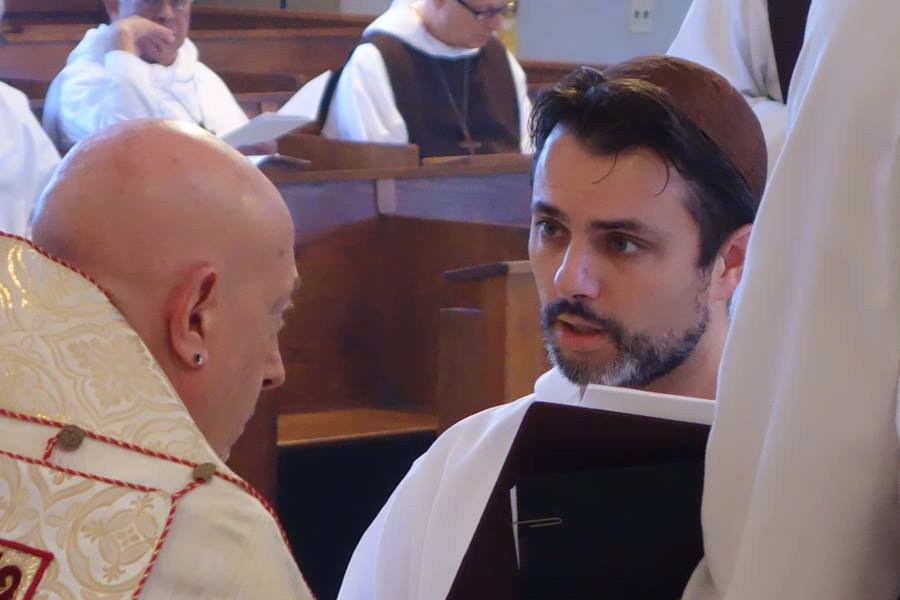
First Profession

Camaldoli Hermitage, Big Sur
The Pacific from Kairos Hermitage at the New Camaldoli Hermitage in Big Sur, California, where I took my pre-profession retreat.

Sit in your cell as in paradise. Put the whole world behind you and forget it. Watch your thoughts like a good fisherman watching for fish. The path you must follow is in the Psalms—never leave it. — St. Romuald’s Brief Rule

The strength of the Brotherhood is dependent on the prayer life of each brother. — from the Rule of the Brotherhood of St. Gregory

What if all the world’s my cell?
not made for me possession steer,
not raise nor bury by ingenuity nor intellect;
not to burn with anger fierce,
nor upend with will’s forcèd strike.

During%20the%20litany%20at%20First%20Profession
During the Litany read in the Solemn Mass and First Profession at Mt. Alvernia Retreat House, Wappingers Falls, New York.

What if, staking life in prayer
and paths of grace,
this cell a paradise becomes,
God’s wondrous and mysterious hands
molding redemption in darkness,
joy in light:

Where windy mountaintops
and deep salt sea,
and fellow pilgrims
sing of watchers and holy ones—
gone before and come tomorrow
and present now,

This den of open sky and silent cave,
of gracious beauty, fierce and fragile,
Where death and life anew and sounds afresh?

Where blades of grass say heaven-sent,
and trees bare naked Spirit work;
Where blooms’ courses run,
and seasons have their turn.

Brother%2520Richard%2520Thomas%2520witnesses
Brother Richard Thomas Biernacki, Founder and Minister General of the Brotherhood of St. Gregory, witnesses my first profession.

Where music plays, sweet cacophony of instrument,
and engine makes a song.
Where kettle sings tea and coffee scent
and family spreads a meal.

Where friends come and go
and strangers sing,
Where children play
and cry and dance,
and elders gather wisdom’s strength.

This haunt of angels
and sun and moon,
Of wind and rain,
and forests’ clamor and silent sands,
and glistening cities, creative mind a team,

And lonely stillness on night wings ’fore dawn.

What if all the world’s my cell?

– with love to all my brothers and special thanks to my mentor, Br. Pete, who has taught me the value of “What if?”

Clothed%20as%20a%20Brother
Receiving a blessing from the Minister General after being clothed in the full habit of profession.


Thursday, June 27, 2013

Grieving a Principle

The overturning of DOMA and effective demise of Proposition 8 in California this week at the hands of the United States Supreme Court bring about a critical moment of justice for those who have been aggrieved for many years: the couples and families who have been denied benefits, access, inheritance shelters, and countless other protections and privileges granted not only to spouses but to their heirs by the government.


Those grievances are real, tangible, documented, and damaging. And they have exacted an emotional and spiritual toll from our LGBT sisters and brothers that will take significant time and effort to remediate and heal. And thousands of other families and couples remain at the crossroads in states that have yet to recognize their most hallowed relationships. There remains much work to be done before their grievances, too, are redressed.

What I question here is the ongoing “grievances” of same-sex marriage opponents, particularly at this late hour. Br. Tobias Haller takes on the whining memo of the Roman Catholic Conference of Bishops, for example. 

Compelling to me is the Supreme Court’s decision in Hollingsworth vs. Perry to deny standing to the advocates of Proposition 8. Kennedy’s dissent, together with the prevailing opinion, makes for an interesting study in what constitutes a real grievance under law (beyond mere disagreement – even if expressed by a voting majority over and against a minority). At bottom is a fundamental question that has been bubbling for me to the surface of this longstanding debate in our Church and culture over marriage:

Who is really aggrieved when a same-sex couple choose to marry?

I suppose, like the Roman bishops, we can argue that some kind of principle – biblical or traditional – is aggrieved. I will leave alone the implied or explicit theological hubris that often quickly follows: that God, therefore, must be offended. But here is where Christian orthodoxy meets the wisdom of secular jurisprudence in the United States: Ours is an incarnational faith, not a theoretical one. Real grievance of the kind we are called to address is the kind that shows up not merely in our principles or theological structures, let alone merely in the taking of personal offense. My grandmother was always fond of saying that there is no accounting for taste!

Real grievance shows up in the tangible, physical effects on the lives of God’s people. The gospels are replete with examples of Jesus making moral argumentation not on theoretical grounds, but on matters that tangibly effect the lives of his followers and audience.  He seems most offended by religious authority asserting theory over practice (a form of hypocrisy), and perhaps even worse, practice or its imposition in the name of God that tangibly brings suffering and injustice upon the people.

And for that reason, Christian morality is most real in this matter only where people suffer not merely an internal violation of their moral principles by the life decisions of others, but an external restriction from sharing in the abundance of God’s creation: love, liberty, dignity, and even such tangible graces as succor, shelter, and food – basics that marriage as an institution can sometimes help ensure.

Standing failed in the Proposition 8 decision because the parties bringing appeal to the Supreme Court could not demonstrate how they had been tangibly harmed by the lower courts’ overturning of the initiative. It is even greater justice that Judge Vaughn Walker’s brilliant and cutting 2010 decision over the fate of Proposition 8 at the District Court level now can stand on its own, especially in the ways it clearly shows the tangible harm Prop 8 wrought on same-sex couples. It is that harm – real and measurable, not merely theoretical – that violates the Constitution and, I would argue on separate yet coinciding grounds, true Christian morality.

Again, Proposition 8 has been shown to be the hollow victory it was – purchased, incidentally, at not only great expense, but by cynically appealing to a most base side of the body politic in California. It is not enough to claim offense and enshrine it into law, even while hiding it behind a hallowed, basic democratic process like a referendum.

The real lesson I wish some of our sisters and brothers would carry forward from this week is that simple appeals to principle or mere assertions about what marriage is will not do. This threadbare, rationally vacuous approach clearly avails little in civil jurisprudence. Nor should it be given any truck in thoroughgoing Christian moral argument.

Grieving a principle is a far cry from the realities of human suffering that our Savior came to address.

Show me precisely how same-sex couples sharing equivalency of rights and privileges tangibly harm my “traditional” marriage, and then we have a starting point for conversation. 

(But as we say in the Midwest: Good luck with that!)


Friday, June 14, 2013

Contemplations

Since I learned how to enter the forest of meditation, I have received sweet dewlike drops from that forest. I have found that the door to meditation is open everywhere and at any time, at midnight, or at noonday, at dawn or at dusk. Everywhere, on the street, on the trolley, on the train, in the waiting room, or in the prison cell, I am given a resting place of meditation, wherein I can meditate to my heart’s content on the almighty God who abides in my heart.” – Toyohiko Kagawa

Journeys with my son, Daniel, this past week, have given us further glimpses into the ministry of the Nippon Sei Ko Kai in Japan, and the heart of what might be regarded as Japanese spirituality. The Japanese people have often said of themselves that they are “born Shinto, marry as Christians, and die Buddhists,” a reference to the eclectic spiritual journey many in this culture follow. And it is true. Bearing witness to this reality are the ubiquitous shrines and Shinto holy places, the Christian wedding chapels more common than congregational gathering places, and the countless Buddhist cemeteries that dot the countryside and cities. Less than 1% of the population is formally baptized into Christianity, and of that, only a fraction are Anglicans. Yet the mystical connection with the incarnation everywhere in Japan is so hard for me to miss, even if very few here would describe their relationship with the earth and neighbor using that distinctly Christian theological language.

Christ Church Cathedral, Sendai, has now been razed due to earthquake damage. The congregation and diocesan offices are temporarily housed in rented space a few blocks away until a new cathedral is built.
On Sunday, at Christ Church Cathedral in Sendai, I had the privilege of speaking briefly to the church women who gathered for one of their regular lunch meetings. Christ Church Cathedral currently meets in a rented space – the original Cathedral and its affiliated diocesan offices were too badly damaged in the March, 2011, earthquake to be repaired. (Shintaro Ichihara and I gently argued over whether the rental space could be deemed a Pro Cathedral...) So now, the cathedra is tucked neatly into the corner of a room that would more likely be filled with filing cabinets, work stations, and cubicles. Each Sunday, the devoted members of the community pack into the room for prayers and eucharist, singing hymns to the accompaniment of an old, revered Yamaha pump organ, and then efficiently rearranging folding tables and stacking chairs for subsequent meetings.

The Rev. Shintaro David Ichihara and I are given a warm welcome on Sunday at Christ Church (Pro) Cathedral.

Nozomi Matsumura, Shintaro Ichihara, Daniel, and Katie Young pause for a shashin following Eucharist with the Christ Church community. Nozomi and Katie contemplate their next adventure as their internships with the Issho ni Arukou Project of the NSKK end later this month, and the project itself undergoes a metamorphosis as it returns primarily to diocesan oversight.


I spoke on Sunday of being moved deeply by my brief visit to the Diocese of Tohoku, and witnessing the recovery efforts of the Issho ni Arukou Project, but most especially by our visit to Okawa, Ishinimaki , where so many children lost their lives to the tsunami. The Buddhist altar and commemoration outside the gutted school, surrounded with so many Jizo, reminded me that contemplation and meditation provide the only path to grasp the reality of such tragedy. And contemplation is at the heart of the Christian path as much as any other. What else are we really doing when we accept a morsel of bread and regard it as kirisuto no karada (Christ’s body) and share in a common cup and call the wine kirisuto no chi (Christ’s blood)? The sacramental life is profoundly meditative, incarnational, and bound to draw us into the seeming contradictions of death and life, tragedy and joy, the spiritual and the embodied. The courage, witness, and perseverance of the members of Christ Church Cathedral and many in the Diocese of Tohoku is a testament to their commitment to this sacramental life, lived out in a world that often may perceive their Christian vocation as strange, and yet through Issho ni arukou, they have become friends to so many struggling to move beyond unimaginable loss.

The interior of St. Agnes Cathedral, Kyoto.

With The Rev. John Masato Yoshida, Dean of Bishop Williams Seminary, Kyoto, in the seminary chapel. 11 seminarians reside on campus in a three-year program preparing them for ordained ministry. Daniel was very generous with his Japanese skills, helping with translation during our visit.


Taking full advantage of our Japan Rail passes, Daniel and I have journeyed around the Western part of Japan since departing Tokyo on Monday. We had the honor of visiting the historic Cathedral Church of St. Agnes, Kyoto, and the Bishop Williams seminary just a block away, where the Dean, The Rev. John Masato Yoshida – who also chairs the Standing Liturgical Commission of the Nippon Sei Ko Kai – took time out of his busy schedule to introduce us to one of the NSKK’s two centers for theological education.

That same day, we had journeyed to Nara, the earliest capital of Japan, where in the eighth century, the Emperor Shimyo had commissioned a massive bronze image of the Buddha Vairocana. The casting of this huge work began when Charlemagne was only ten years old , the Gregorian mission to Canterbury under Augustine was barely older than the parish I now serve in the United States, and all of Christian Europe was starting its long journey through the Middle Ages. Keeping that ancient historical parallel in mind added only the magnificence of this contemplative statue that epitomizes emptiness in meditation. Moreso for me was the mental image of Buddhist monks standing together in the statues upturned hand. Our guidebook mentioned that four or five might be seen there together during the statue’s occasional cleaning. 

It’s hard to capture the grandeur of the Buddha Vairocana statue in 東大寺 (Todai-ji Temple), Nara. Imagine four monks standing in the upturned hand, and you start to get the idea. This famous site, housed in one of the largest wooden structures in the world, was overflowing with school children visiting from all over central Japan.
It reminded me of the way Japan sits in all of its vitality in the hand of the divine that we call God, holding together enormous contradictions in contemplation: building, rebuilding, preserving, and constantly reinventing on land that can move at any moment; at the edge of the sea that can overpower even the cleverest of human endeavors at any time.

In the West, we often work hard to resolve contradictions, and too often pursue a false consistency that relies on more denial of reality than anything else. We can gloss over life’s inconsistencies and race ahead in the pursuit of an unrealized future we never reach. We can fill our hearts with the gruel of self-righteous “productivity” while neglecting the cries of needful souls around us. All the while, we miss the power of the present moment – no matter where we are – and what God offers us there. Our Christian sisters and brothers in Japan, drawing on not only the lessons of being minority missionaries amongst their own people, but on the deep heritage of their culture, remind us that contemplation – meditation – is one of the great teachings of the sacramental life, and through this most intimate kind of self-emptying prayer, we connect in the holy present as Jesus did and the saints have done for millennia. 

We then can allow the infinite mercy of God’s grace to connect to us, that only resource that can help us serve in the face of any tragedy and overcome all challenges as part of the Body of Christ, living beyond death.


Sunday, June 09, 2013

Let Them Live Again

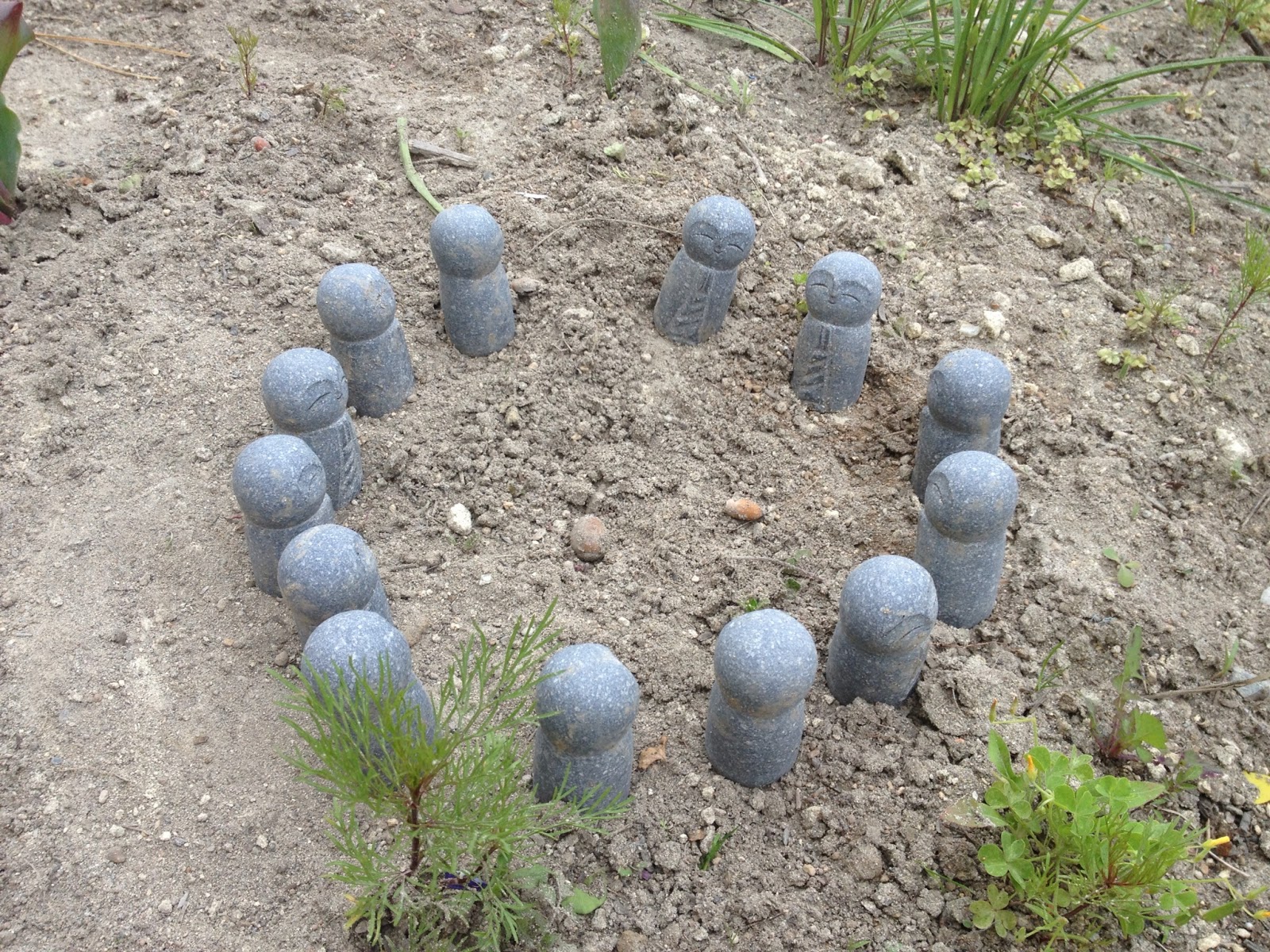
At the original Fuji Kindergarten, Yamamoto,  Jizo – statues of spiritual beings believed in Buddhism to shepherd the souls of deceased children, protect the living, guard travelers, and reside at the thin places between life and death – are placed in a circle in the memorial garden to honor the students who died there and the teacher who gave her life to save many others in the March 11th, 2011, tsunami.

A sermon delivered at Christ Church Cathedral, Sendai

by The Rev. Shintaro David Ichihara

trans. ed. The Rev. Br. Richard Edward Helmer

The Third Sunday after Pentecost

For the past few weeks, I have struggled with what it would mean to preach in Sendai, since both the Gospel and Old Testament readings today are stories of dead sons being restored to life.

This weekend, Richard and Daniel Helmer and I visited several parts of the Diocese of Tohoku. It was a first visit for Richard and Daniel to these tsunami-devastated areas; I had seen them before. Nevertheless, Okawa Primary School still had me at a loss for words. All that I could offer was Elijah’s prayer: “O Lord my God, let this child’s life come into him again.” And, of course, this is the cry of parents who lost their children to the tsunami. It is profoundly difficult for me to preach about this from the pulpit, thinking of the reality that these families must continue to face.

One commonality found in the two stories we hear today is that the dead in each instance is the only son of the family, and he is survived only by his widowed mother. This means the widows faced a very difficult future. In their societies, a woman could not live without a patron, whether it was her father, her husband, or her son. Lacking all of them, the widows’ plight in these stories was without hope.

Elijah and Jesus both fought with this reality, and yet we know in our earthly pilgrimage that the sons of widows and countless innocents will not be raised today from the dead. The harsh reality is that the families of the victims of the tsunami remain in deep sorrow and pain, and they may never find full healing. So how, then, does today’s word speak to us?

A few weeks ago, Genji Yamaura, a Roman Catholic doctor who translated the four gospels into the Kesen Japanese dialect (spoken in the area of Ofunato) delivered a special lecture at Rikkyo University, where I serve as a chaplain. During the lecture, he invited questions from the audience. One question was, “Why do so many innocents have to experience such hardship? What do you think?”

Mr. Yamaura replied that after the earthquake and tsunami, he reached a simple conclusion: every human being dies. Regardless of the cause of death – whether tsunami, earthquake, or cirrhosis of the liver – everyone must face death. The implication of the question itself is that good people should not die, while bad people should. As you know from experience, this is nonsense. Jesus himself said that natural disaster is not a punishment from heaven. Even if people have to endure great hardships wrought by disaster, it does not mean they are making recompense for some kind of sin. God created the world so that everything on Earth might enjoy life. We are ultimately God’s instruments. Our only task is to attend to the world’s reality while listening to God with a pure mind and await the enlightenment God promises to give us. This is our most important task in life, even as we face the fact of our ultimate demise in the future.

Elijah did not have the power to compete with the desperate power of death on his own. He could only ask for God’s power to restore the boy’s life. Jesus happens upon a group of people in a funeral procession, and he has compassion for the boy’s mother. As many of you know, the words “have compassion for” implies a visceral response: a feeling in one’s abdominal organs. In the Gospel of Luke, “compassion” regularly appears with the words “see” and “approach.” The deeply seated reaction of compassion is what compels Jesus’ actions; compassion is what brings the dead son back to life.

After visiting Shinchi, Richard and I talked about the gospel for today. We had just heard the tragic story of Fuji Kindergarten and wondered how it intersected with the story of the widow’s son being brought back to life. Richard suggested that the regained life was a communal life. Not just the restoration of an individual’s physical life, it is much more: it is restoration of life in community.

Even though we all pray for return of life to the dead, we struggle with our lack of power to make it happen. Moreover, we all face a destiny of death someday, for which there may be no explanation. Yet isn’t it possible for us to see the reality of both life and death, to approach them – using the words of Luke – and to find in that approach the compassion to help recover the people lost in sorrow? While we do not even have the power to heal sorrow, we do have the power to help restore their life in community. In this sense, the focus of regained life is not just for the sons, but also for their mothers.

We are approaching an important milestone of the Issho ni Arukou Project. At this time, I feel we are called to listen to the word of God, who brings hope that everyone in such deep pain and sorrow may be restored to the fullness of life in community. Regardless of what happens next with the Project, we Christians are called to lead our lives after the example of Jesus, who sees, approaches, and has compassion; who says, “Do not weep anymore.” 

This might indeed be the special calling at this time for the people of the Diocese of Tohoku.