That Not-So-Sweet Jesus
Delivered at Church of Our Saviour, Mill Valley, California on March 1st, 2015
Jesus said, “I have come as light into the world,
so that everyone who believes in me
should not remain in the darkness.”
John 13:19
Sermon Notes for the Fifth Sunday in Lent, Year A
Readings
Most of us gingerly dip our toes in the waters of faith through hope. I hope there is more than this life. I hope the virtues like love and fidelity are worth it. I hope death is not the end. Hope is given as a Christian virtue, of course, but I find it somewhat remarkable that I can’t come up with a single verse in any of the gospels that Jesus commands us to hope. It’s only a word that appears in his absence or expected presence.
And so we come to another of the great “I am” statements in John this day – John’s rewriting of the familiar and ancient Torah, beginning with the creation narrative, disclosing as he did to us last week that by working in Jesus, God has not yet arrived at the seventh day sabbath rest… and this day recounting another play on the “I am” of the burning bush, the divine disclosure of being both primordial and eternal, both transcendent and imminent, both wholly other and fully present.
The focus is on the stinking tomb of Lazarus, that festering wasteland of death that haunts so many of our worst fears and wrecked dreams. John does not hesitate to ladle every possible oppositional force into the story, reminding us that Christ, the Word of God’s great “I am…” is up against every conceivable human obstacle.
On discussing making the journey to Judea, the disciples are rightly worried their teacher is walking into the inevitable, deadly trap of the religious and Roman authorities in the Jerusalem orbit. Thomas, ever the realist bordering on cynicism, offers resigning snark worthy of twenty-first century:
“Let us also go, that we may die with him.”
John must want us to feel the inevitability in this story we all feel about the finalities of this life, the surrender to forces beyond our control, the undeniable reality of our suffering and the press of death.
Mary is too grief-stricken to greet her friend and savior. Martha, the more pragmatic of the two sisters meets Jesus with a thinly veiled accusation:
“Lord, if you had been here, my brother would not have died…”
followed by a thin sliver of hope:
“But even now I know that God will give you whatever you ask of him.”
But when Jesus offers unwavering assurance that her brother will rise again, Martha retreats to an abstraction about the resurrection of the dead on the last day, somewhere off in a murky future where hope for a struggling life might find some projected justification. The present suffering of loss –a brother, breadwinner, and kin companion in life’s brief journey gone – is just too much for hope to bear.
And so it is for Jesus when he arrives at the tomb and weeps with his companions. John compels us to consider a God who does not will our suffering or plan it to test us or use it to punish us, but rather who enters into it with us. This is a dangerous God who is not manipulated by clever prayers or incantations or pleased by the bribes of priests or even by our most righteous piety. This is a God who suffers with us, sheds tears, breaks with our hearts, and feels the gnawing reality of our finitude. This is a God who knows our limited vision, the real humility of our impotence, and the uncertainties that grind away at even the most vibrant faith.
This is a God who risks all danger to be with us at the very end, in the dark and bitter deaths we all inevitable experience.
And, a bit like Ezekiel, Jesus, when confronted with the undeniably dead and dry bones of every broken dream, promise, and ended life, does not respond to the question, “Can these bones live?” with a tepid “I hope so.”
Hope is not enough, at least not as we understand it these days as a shrug in the face of all human limitation. Instead, Christ, like Ezekiel, surrenders to the sublime power of the Creator: “Oh, Lord God, you know.”
“I am the resurrection and the life,” God in Christ says to a hopeful Martha and to us in the sacraments, at our deathbed, in our suffering, and in our darkest hour of despair. So stubborn is our promised salvation, it will not yield to our tepid hope or our deepest hopelessness. So stubborn is God’s love for us, it will not be confined to platitudes or vague projections about an afterlife. So stubborn is the resurrection that Jesus embodies, we can only respond with the silence of Lazarus as we are raised from our own stinking tombs, and ordered set free by the great I AM.
Sermon notes for the Third Sunday after the Epiphany.
Audio of the sermon delivered at Church of Our Saviour, Mill Valley, California
Someone remarked to me this week that I had chosen – in this particular vocation of serving the Church – what he called the “wild ride.” I hesitated for just a moment, tempted as clergy are all too often to see our calling as elevated or separate from most other Christians. On the one hand, it’s true: being subject to the uncertain future of a relatively modest not-for-profit budget that relies almost wholly on others’ generosity; social forces well beyond my control that might make churchy business popular, unpopular, or indifferent tomorrow; being on call when people are facing life-altering events that few witness with any regularity. . .well, it is a “wild ride” at times, indeed!
But then I recognized that few, if any of us, can say with any validity that we are not subject to the uncertainties of the present state of the world, or that we are secure enough to weather social forces no matter which way they trend, or that our particular line of work will sustain us in two or five years, let alone ten. Truth is, all of us are confronted with a “wild ride” of one sort or another. And so I say again, paraphrasing Wesley in The Princess Bride: Anyone who tells you otherwise is selling something!
On Facebook this week, I came across the perennial article remarking on how the institutional church is faltering: How it has failed and hurt many over the centuries, and whether or not it deserves to survive. The curious thing was that I read one article like this and then another popped up on my Facebook news feed, and then another, and then another! I wondered for a moment if everybody was starting to write again about the demise of institutional Christianity (a familiar and depressing thought for a guy like me). Maybe we really were going to at last go under. But then I realized Facebook was only doing what it was supposed to do – posting articles on my news feed similar to ones I’d already read. It’s the same kind of consumer-driven content selection that all our media and social outlets now employ at every turn, every mouse click.
What struck me about that is the rapidly distorting effect this has on our perception of reality. We can quickly find ourselves in an echo chamber hearing only voices that think about the same things we do, and think that therefore the whole world is discussing what we are; or worse, that a majority of the world thinks the same way we do! What makes this doubly troubling is the modern myth that with all our access to information these days, we are getting a more “unbiased” view of reality than did our ancestors.
The first piece of good news, then, in today’s gospel, is that we are in this way, at least, similar to Peter, Andrew, James, and John living on the shore of the Sea of Galilee. They didn’t have mass media or access to mobile devices to distort their view of reality with consumer-driven content. But it was still probably hard for them to imagine much reality beyond that which they already knew and talked about all day. Fishing was and remains another all-consuming “wild ride” subject to forces well beyond human control: weather and the almost complete mystery of the biology beneath the waves. Whether their catch would be big or small must have been a combination of seasonal guess-work, intuition, and fate into which a faithful fisherman might have injected a good dose of prayer. But no matter the size of the catch, there would always be the endless work of disentangling and mending the nets, countless hours of dropping them here or there in the waters and hauling nothing, and the gnawing uncertainty of whether even a good catch would sustain their livelihoods for another cycle of moons.
These first disciples, doubtless, talked, breathed, and dreamed fishing. It was what they knew best to their very bones. And so, when this itinerant teacher, filled with the Spirit of God from his venture in the wilderness, shows up and commands them to follow, I can only imagine their perplexity when he told them they would now “fish for people.” They will spend the next few years on this “wild ride” with Jesus, learning better what he means by that from the greatest teacher of them all: experience. They might even come to learn that this is no ordinary mystic, prophet, or teacher they are following. This might just be Someone who reveals God’s presence with us in the flesh.
For Jesus, his time has come, and none of the signs are good. John has been imprisoned, and no sensible person would believe anything other than Jesus was next on the hit list. It will take time for Peter, Andrew, James, and John – even a lifetime – to learn what Jesus has just learned in the wilderness through his confrontation with temptation: by rejecting the offer of the powers this world recognizes – the power to satisfy ourselves and lord it over others – Jesus has planted the flag of a new kind of community that will involve radical self-offering, radical non-violence, and, therefore, radical vulnerability.
This will not be a wild-ride in a chariot or alongside a marching legion or the grit of a violent insurgency. It will be a wild ride of profound vulnerability to people’s love or painful rejection; it will be a wild ride in the midst of a confrontation between the ways of a God who lovingly made all that is with a world that is too often hell-bent on distortion, dissension, division, domination, and destruction.
No doubt, Jesus saw this likely ending with a cross. Had Peter and Andrew really understood the reality they were stepping into, would they have dropped their familiar nets and followed? Would you? Would I?
Repentance for them was not simply getting it right with God so things could go back to the old and familiar. Paul must confront this very human temptation bearing bad fruit in the little clutch of Corinthian Christians today, and while his message is at times amusing (just how many people did you baptize there, Paul?) it is steel-edged with worry that the faith he gave them is being quickly sandblasted by the dry winds of familiar factionalism and quests for domination and control. They haven’t gotten repentance yet, and so they are at the same risk every formalized Christian community and every half-converted heart has been since: just going the way of thousands of other spiritualities and religious institutions across the millennia. And that is nowhere at all really, except back into the familiar teeth of a power-hungry and hell-bent world.
So when Christ calls us to repent, he is not merely telling us to be good Christians working on our own righteousness, finding the right cause and standing up for it, and then hoping to end our short lives having done good things. If that were the case, we could see Sundays as only a time to gather, utter faithful words, mend our nets, collect our rations at the altar, organize a bit, and then go out and simply do “it” better.
No, repentance is more like Jesus coming to the shore of our familiar lives and calling us out of our familiar but distorted, insular view of reality, and us daring to follow him into a wild ride that is truly unfathomable — a ride with God that, inevitably, will overturn everything we thought we knew about ourselves, the world, and even our most cherished values and beliefs.
Didn’t you learn that somewhere along the way? Maybe in Sunday School? No? Then the institutional Church, you see, is still trying to get its job right, and two thousand years later is still falling far short. Paul is addressing us as much as he is that quarreling little sect in Corinth all those centuries ago!
But not to worry. Our little community is rooted in grace, not institutional righteousness. And the school of repentance for Jesus was not confined to the synagogue. It was ever engaging its students at the side of the sea, at the booth of a tax collector, in the kitchen, seated at table with friends and enemies, under a tree, or even up a tree! For us, the school of repentance is found, too, out there in the world at least six other days of the week, when we each must grapple with our own “wild ride” and perhaps find ourselves called yet again out of the familiar, the predictable, and the ever budding arrogance of our own narrow judgments about reality. Here we gather in the hopes of being reminded of this humility and re-fueled for our journey by the life-blood and strength of our Savior, exhorted by word and sacrament not merely to do better, but be affirmed again that we are on this wild ride together with one another and our God.
And so we can truly repent by pursuing that journey that Jesus’ first disciples were on: where the flag of a new kind of community, a new kind of people, a new kind of world is carried...
A world built not on the foundations of power, but of radical self-offering and self-emptying...
So that we each may be filled with the love that God made us to have, a love that even promises to bring life beyond all death.
Sermon for the Confession of St. Peter
January 18th, 2014
delivered at the Winter Convocation of The Brotherhood of Saint Gregory
The Chapel of the Stigmata
Mt. Alvernia Retreat Center, Wappingers Falls, New York
Among the great blessings of my childhood and youth were trips to rural Gloucestershire to visit my English grandparents. Even now, simply reflecting on it brings back the scent of freshly cut sweet pea blossoms on the kitchen table, the yeasty smell of the pantry where my grandfather fermented homemade wine, and his aftershave scenting the little office beyond, cluttered as it was with papers, books, and the typewriter where he tried his hand at writing for many years.
Above his desk was a little wooden plaque that read:
“Engage brain before opening mouth.”
You might think for a moment I will be relating St. Peter today to my grandfather — a self-made and largely self-educated man, a man of simple trade, and yet amongst the wisest people I knew growing up.
But, no, I would better relate my grandmother to Peter. For our beloved Rona, to say it was to think it. She was the positive antithesis of that delightful little sign in my grandfather’s office, which is probably why it remained in his office and nowhere else in the house, and you can only imagine the fascinating relationship they cultivated for over fifty years of marriage!
My grandmother had married well below her station. To employ a bit of British understatement, her family that included a captain in the Royal Navy was not at all amused when their daughter found herself backed by love to marry into trade — namely, the floristry trade. But that she did, and so without the roadmap of family sanction, she and Stanley built a life and started a family together around his floristry business in London. They in turn found themselves backed by geopolitical forces far beyond their control into lessons of survival and perseverance through the war years.
They narrowly escaped death on at least one occasion when a German shell leveled their little shop. Gathering stubborn resolve for survival from that experience, Rona learned how to deal effectively with annoyed customers, difficult characters, and guide anxious brides and grieving families to the right floral design. All the while, she and her husband worked grueling hours, rising in the dark to gather fresh flowers for the day from the market, working late into the night to prepare for weddings, funerals, holidays, and every need for a bit of beauty that came in the door, and raising two children. Years later, as Stanley watched his professional colleagues drop dead of exhaustion in their early fifties, he and Rona decided to sell their business and purchase an old hunting lodge in the West Midlands. There, Stanley was determined to slow their pace of life, pick up gardening, and become a published writer.
But Rona, with no roadmap yet again, found herself backed onto a new, unexpected path, and so she began to teach. And she started writing about flower arranging, too, and was quickly published. By the time her first American grandson was born, she had become the primary breadwinner of the household, having built her little floristry school into an internationally recognized training ground for aspiring and experienced florists alike, all based in the studio she had designed and built.
In the seasons I would visit, we would sit together for tea and fine cheese, and Rona would still always speak her mind. Didn’t matter if it was politics, the beautiful garden she and Stanley cultivated, religion, church gossip, music, neighbors, or the weather. She articulated a strongly held thought about almost everything. And so Stanley would sometimes say in exasperation, if for no other reason than to end the volley of unsolicited opinion:
“Yes, dear, you could be right.”
Following his death, she told me on at least one occasion with a laugh that she learned early on not to be bashful about having the last word. And hers was a one-liner worthy of the Dowager Countess of Grantham:
“Not only could I be right,” she would sometimes respond to her husband, “I bloody well am!”
Rona lasted into her nineties, impetuous and opinionated as ever, and in many respects more successful business-wise than her more careful and studied husband had been. She was never the charmer that the self-made gentleman Stanley was, but at least you always knew where you stood with her. Her mottos included an honest wage for an honest day’s work and making a commitment to “keep the tide coming in.” A cousin even noticed that one of Rona’s books made a cameo appearance in the opening credits of the BBC comedy, Keeping Up Appearances. Her floristry school was taken over by a colleague and continued to flourish after she moved to the States to live with my parents.
Rona’s other favorite expression, which to this day I find myself using on occasion, was always about so-and-so undertaking something “of his own violation.”
Now that’s Peter in a nutshell, isn’t it? Always impetuous, always undertaking actions “of his own violation.”
Peter finds himself backed into dropping his nets at the seashore, abandons the familiar life of fishing for an uncertain future following this strange yet alluring, itinerant teacher. Peter jumps out of the boat to walk on the water. Peter is ready to enshrine Jesus, Moses, and Elijah on the mountaintop and is answered by more than awkward silence. And Peter, today we remember, boldly calls Jesus Messiah and Son of the living God, and suddenly in a truly inspired moment for once, finds himself in the right. Then, before the sound of his confession fades in his own ears, he is handed the keys to the kingdom and is named in an instant of affectionate word play, “Brother Rock” if you will, a first stone for the foundation of the Church.
Yet we have good reason to doubt Peter knew precisely what he had really said or what any of this really meant. A scant few verses later, he will attempt to block Jesus from turning towards Jerusalem, and his Lord and Master will be vexed enough to call his first disciple Satan. Clearly, divine inspiration or no, “Brother Rock” had yet again opened his mouth without engaging his brain.
And it will go on. After promising not to, he will betray Jesus three times during the Passion. He will be skeptical when reports of the Resurrection are brought to him. Even after witnessing the Resurrection himself, he will clothe himself with embarrassment and jump impetuously into the water yet again, and yet still be befuddled when the arisen Christ commands him to feed his sheep. On the way to fulfilling this charge, he will argue vociferously with Paul, struggle with intractable disputes of his little community, and learn through mis-steps and unexpected visions that God still has yet even more to reveal. Nevertheless, he will still successfully lead the first Christian community in spreading the Gospel in word and deed: healing the sick, sharing the Spirit, organizing and exhorting, testifying boldly before powers and principalities, and even bursting the shackles of prison.
This week, in our own way, we Gregorians have recounted the uncertain footsteps and impetuosity of Peter as he discovered his walk with Christ. We have spent time with minds and hearts buried together in our Rule and governing documents, recounting how our Founder began this community “of his own violation” as Rona would say, and how he and subsequent companions on the way jumped impetuously and dangerously into the water, went off on tangents, said and started things they didn’t quite understand at the time. . . or simply didn’t understand at all, and yet found God inspiring, leading, and revealing things they had never imagined.
But then, that’s true of all of us, isn’t it? It’s one reason why we gathered here again to talk about humility, being broken open again and again for Jesus to plant seeds in us, and about the virtues of traveling light and allowing Christ to open our eyes. It’s why we spent time this week endeavoring to understand ourselves better, both as a community and as individual brothers.
Yet we are like many ancient tribes and like Peter himself, in that we are really walking backwards – not forwards – into the future. The ancients understood that hindsight is truly the only way we see, and so it is the future, not the past, that is behind us. Now, we might be tempted to see our evolving governing documents in particular as some kind of roadmap, some pathway forward, but they are really only lessons from experiences of the past, helping us —at best — to keep our footing while we walk backwards – or, perhaps a bit more accurately – to gather a bit of confidence and hope that we will more than survive when we, like Rona and like Peter, find ourselves backed by love and life into a future that we can only best describe as unexpected and unplanned.
The philosopher and prophet of our modern media age, Marshall McLuhan, coined the familiar phrase “the medium is the message” and the term “global village.” He also said, gathering up this ancient wisdom, “We look at the present through a rear view mirror; we walk backwards into the future.”
And, yes, it is always dangerous to walk backwards: no constitution or customary or amount of self-awareness will make religious life safe. My brothers, we are called to remain unsafe and impetuous at times, just as Peter was; to proclaim Jesus Messiah and Son of God, and not know what the hell we are talking about some of the time or even much of the time; to undertake ministries and tasks “of our own violation”; and, indeed, to open our mouth sometimes or often without engaging our brains; to risk offering the gift of the Spirit working in us despite ourselves.
And it is this risk that continues to allow the kingdom to unfold among us and through us for the sake of those we serve, so that perhaps in the final analysis, we can with Peter learn finally to become the media and the message for Christ in this global village of ours. We might in the process show in word and deed that not only could Peter be right, he (bloody well!) is right that Jesus is indeed Messiah, the Son of of the living God:
Christ at work for the redemption of a whole fragile, tender, beloved world.
A reflection for the Second Sunday after Christmas
Readings include Matthew 2:1-12
The visitation of the Magi has always been one of the more fascinating – and memorable – stories of the Christmas season. From my wondering as a child at the seemingly exotic nature of these travelers from the East, to the fabulous annual productions of Amahl and the Night Visitors I had the privilege of seeing while studying music as an undergraduate, there is something about them that captures our imagination. Part of their mystery is their origins: were they Persian priests of Zoroaster, Babylonians, Arabians, or Jewish leaders of the diaspora from contemporary Yemen, or some combination of all of these? Were there three or more? A plethora of traditions arose around and about them. In the Eastern Church, they number at least a dozen in some depictions. Tales of their later martyrdom for Christ spawned relics into the Middle Ages. But Matthew, the only canonical gospel who records their visitation, gives us precious little to go on. The author himself may have had his Jewish audience in mind as the story in some ways parallels the tale of the King Balak and the prophet Balaam in the Torah, complete with a messianic star (cf. Numbers 22-24). That Matthew also intends to show the revelation of Jesus to the Gentiles may also, of course, be on the agenda.
But our fascination amounts to much more than that:
Who are these mystical figures really? And why does their story speak to us?
Part of our fascination with them is their deft handling of Herod, the crafty Judean politician, son of an appointee of Julius Caesar. Herod clawed his way to kingship by aligning himself with the Roman occupation, re-conquering his own homeland with Roman aid, and then lending legitimacy to his rule by marrying into the legendary Hasmonean dynasty, whose fame was rooted in the celebrated Jewish Maccabean revolts of centuries past. Herod the Great’s success (his building projects in Judea were more than impressive) was matched only by his ruthlessness (it is during Christmastide that we also remember accounts of his slaughter of innocent children in Bethlehem in an effort to protect his throne from the prophesied Messiah.)
But Herod’s carefully crafted and paid-for rule is trembling with fear when word of a new king’s birth is whispered in his ear and these strangers from the East come looking for him. Yet the wise men catch the scent of Herod’s fearful scheming through their wise observation and dreams – they are whole, it seems, in their engagement with the universe and the sacred; holy mystics – rulers perhaps – of a different order than the unholy, violent, divisive and soul-rending political machinations that make up Herod and his ilk. The Magi are sacred watchers of signs in nature and the solitude of sleep; faithful stewards of ancient wisdom buried in the very foundations of history and the human experience – wisdom that speaks of our need for a savior, of God to come among us to restore our wholeness.
Recently, I had the privilege of one of those all-too-rare pastoral conversations with a stranger: a seeker from the wider community. For years she has struggled mightily with memories of a profoundly traumatic childhood: trauma that led almost inevitably to struggles with addiction and the law. She had done so many things right more recently: residential programs, therapy, psychiatric care, engaging recovery groups to address her compensating addiction, grappling with various diagnoses...some wrong, some right...struggling with how medication made things better...and made things worse...She had taken every step you can imagine to find and fight for her healing. But still not a day would go by that she didn’t re-engage with the awful memories of her youth, sometimes triggered unexpectedly by things that would seem to most of us innocuous.
She visited me and wondered aloud through tears simply why she couldn’t get over the traumas of the past. Her prayer life is vibrant, she continually offers thanks to God for every daily blessing, she knows scripture well, she places high expectations on herself to let go of anger and forgive those who harmed her, she struggles faithfully to keep her family together. Why doesn’t God just fix things inside her and punish the guilty as a reward for her fidelity? Why can’t she just be healed so she can be a better help to her family and friends?
It was these questions that were worthy, I realized, of the Christ-child, and the long, uncertain journey of the Magi. That the Magi and Jesus would experience a world that was as brutal in some ways as hers is a given. The Magi had to face Herod. So did the Holy Family. Neither of them fixed the situation politically or saw Herod brought to justice. The Magi simply evade Herod on the way home. The innocents of Bethlehem will be killed. John the Baptist will be beheaded and Jesus will die on the cross in part because of the machinations of one of Herod the Great’s sons and heir. Imagine the very different and somehow more familiar story we would have had the Magi remained with Jesus and conspired with him against Herod. The political messiah everyone, even Herod himself, expected, would be just another dynasty battling for power – perhaps with an Eastern alliance opposed to Herod’s Roman one – the Nazorean political family possibly rising and falling in history, like the Hasmoneans, the Herodians, or the Caesars.
One of our alternate gospels today talk of Joseph and Mary fleeing to Egypt to protect the infant Jesus from Herod’s murderous designs for a time. Exile is an inevitable and un-fixable part of the human condition: one that Jeremiah speaks to again on the Second Sunday after Christmas. And that exile has many forms: political, social, relational, familial, and even that awful internal divorce between our heads and hearts, between our inner private and outer public lives. And then there’s the cross that holds it all up for redemption, which is hinted at to Mary even while her first-born destined to be baptized the Son of God still grows in her womb.
“What if,” I asked this stranger who became no-longer-a-stranger in my office, “your struggle is a struggle we all share? One that Christ shares with you?” Sure, her memories and journey seemed harsher than most, but our our most holy journey in common is the struggle with our woundedness.
“What if Jesus isn’t on the outside waiting to fix things, but in the very midst of your struggle with those traumatic memories, standing with you in those awful moments, sharing those wounds with you?”
I found myself offering advice I was once given by a wise counselor in a broken moment: to remember and suffer is as human as it gets. To struggle with woundedness is not so much a “fixable” reality or one to be gotten over, but one to be lived into faithfully as a journey every bit as important as following the star in the East – our wounds are a reality into which we invite Jesus for redemption, not one we try to fix before we meet him. To struggle with forgiveness itself is a process: not simply a switch we throw in our heads. To weep over difficult memories is simply to weep, a most human and Christian vocation. And then to give thanks is to offer this precious gift of Christ in our midst the very best we have to offer.
And then when we remembered her children, some of whom are now successfully engaging adulthood, she brightened considerably. Despite her own struggles, she had already been a help to them and a loving support in ways she might not even be able to imagine. And then there were those to whom she witnessed every day walking alongside her in recovery. Her ministry in grace had already begun, and had been unfolding for a long time. She didn’t need to wait until she was completely healed or perfect, or even just until tomorrow. The life of Christ had already been unfolding in her. Like the exiles’ return in Jeremiah, her journey home was palpable, ongoing, and will be ultimately joyous even if, like the returning lame and blind, she – like all of us, and even like our beloved Christ – still bears the wounds of this life.
It is this wisdom, perhaps, that the Magi knew as they journeyed great distances, asking questions, following uncertain paths, knowing their own brokenness and limitations and learning and re-learning the brokenness of the world, and yet at long last kneeling and worshiping the Christ-child and offering their greatest gifts in homage. . .
This divinity born vulnerable and human as a child among us, who is birthed into all our wounded places, shares our scars and sorrows and even our death, and yet knits a broken cosmos back together; who is driven into exile himself, and yet invites us on the long journey home from all of our wounding exiles from self, community, and God; who is worshiped by strangers sometimes more faithfully, it seems, than the recognized faithful among us; and who is revealed as the Savior of All as the darkness turns to light and the star ascends in our hearts.
I’ve been reflecting a great deal recently on a besetting sin of my generation: entitlement.
This past Sunday’s story from 2 Kings — one of my favorites in all of Hebrew scripture — vividly illustrates what can happen when our entitlement encounters God’s grace and gets in the way.
It has me wondering about how entitlement operates throughout our culture, and in a strange twist, how it drives the current mess in Washington. By strange I mean ironic, as a political movement pushing the damaging government shutdown and potentially dangerous debt-ceiling impasse suffers from an overgrown sense of American entitlement while simultaneously calling for “entitlement reform!” Granted, reform is needed for every sense of entitlement, and we all could all benefit from more than a little self-examination.
But what cure is there for the sin of entitlement?
The great ancient warrior Naaman teaches us about the powerful medicine of gratitude.
I say more in my sermon this past Sunday.
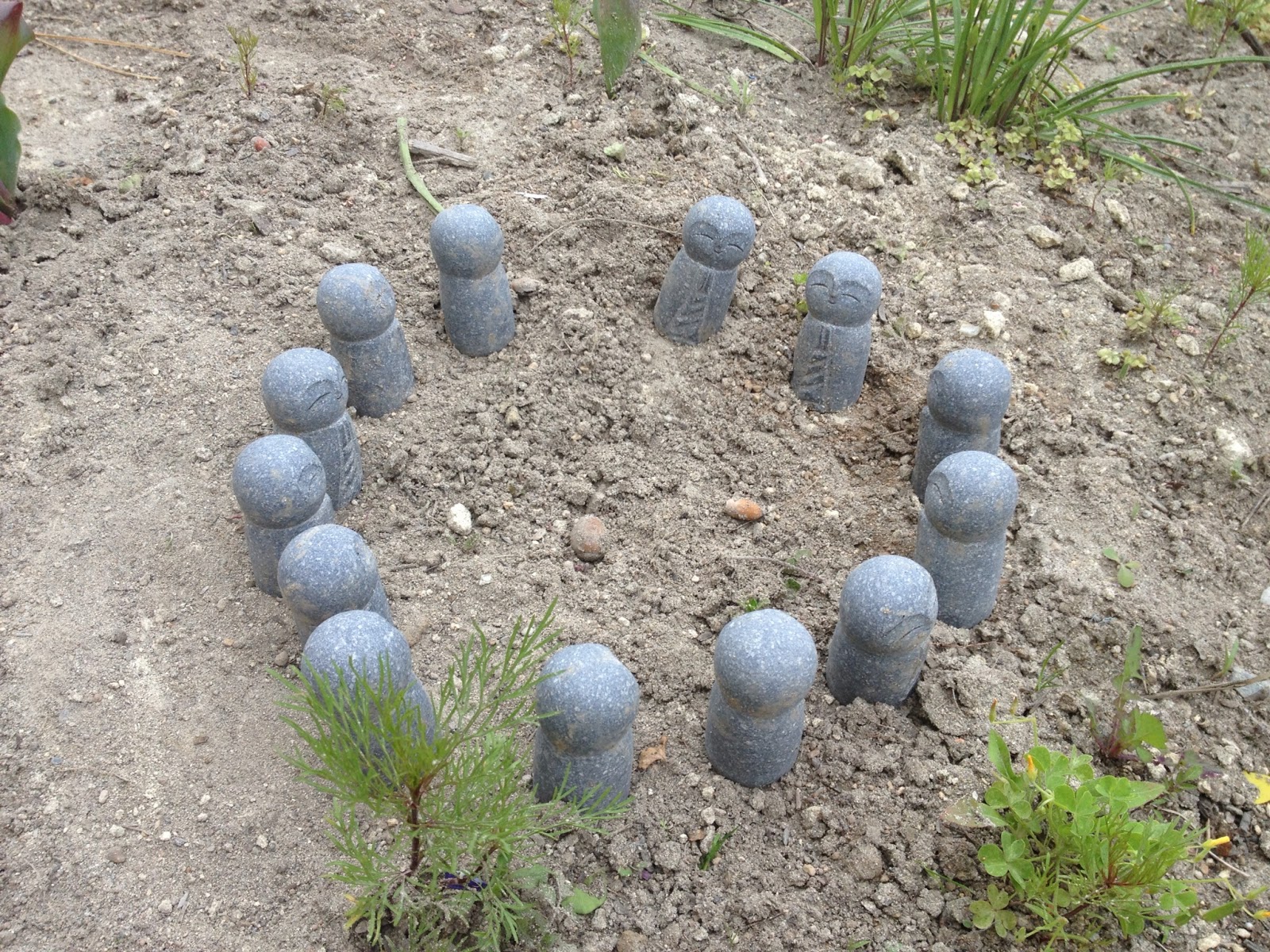
| At the original Fuji Kindergarten, Yamamoto, Jizo – statues of spiritual beings believed in Buddhism to shepherd the souls of deceased children, protect the living, guard travelers, and reside at the thin places between life and death – are placed in a circle in the memorial garden to honor the students who died there and the teacher who gave her life to save many others in the March 11th, 2011, tsunami. |
Br. Richard Edward Helmer n/BSG
Sermon at the profession service of The Brotherhood of Saint Gregory
Annual Convocation 2012
Saturday, August 18th
Chapel of the Stigmata
Mt. Alvernia Retreat Center
Wappingers Falls, New York
Jeremiah 17:7-8 / Ps. 139:1-7 / Corinthians 6:1-10 / Matthew 6:25-33
It was a peculiar and ironic honor to be invited to preach at this year’s profession service: Peculiar, because my habit needs at least another year’s worth of stains before this community considers offering me a bib! Ironic because I speak today to vows I have yet to undertake myself. Ironic, too, in the crazy mixed up way I was reminded this week as I stood in proper order behind Br. Millard to receive communion – which reminded me of that delightfully confused verse of John’s gospel: “He who comes after me ranks ahead of me because he was before me...” (1:15) But before getting tangled up in the potential arrogance of using that verse, I flee to another perhaps more appropriate verse of John: “I am not worthy to untie the thong of his sandal.” (1:27) A much more worthy verse of unworthiness, if you will – in a week where not only do we stand in affirmation of Millard’s first profession, but William Henry’s life profession; in a week where I find myself pushed by the tide into the middle of this body as we welcomed four new postulants and clothed two novices; in a week where with tears of sorrow and hope we recounted and remembered the life of our beloved brother, Michael Elliott.
Who is worthy to untie the thong of anyone’s sandal in such a cloud of witnesses? Or count the achievements of grace in even a one of us? Jesus challenges us this day and every day to step out of our anxiety about ordinary clothing and food and into this great, mixed-up, ironic life of grace where order is drawn from chaos and chaos made of order, where life is greater than clothing, even greater than food; where indeed, as Paul writes to a young, confused Christian community in Corinth that we are called to be servants, to be witnesses enduring all the ironies of this life.
Like many of you the last few weeks, I spent evenings glued to the Olympics. After dinner and dishes, I would sit in my comfy armchair while my family and I would behold human achievement at its apex playing out before millions of on-lookers like us.
One of the events we watched almost every evening was diving. As a musician, I practice for ten hours for perhaps ten minutes of performance of a classical masterwork. Yet it remains difficult to imagine training for years and years to perfect a mere one-and-a-half seconds in the air and then have my whole future riding on that tiny fraction of time.
Catching my attention one evening between the crowded field of athletic prowess, the blitz of commercials, and the endless inane chatter of commentators – my wife has acquired Olympic skill with the mute button – came the words of David Boudia. At one point when he was caught for an interview between dives in the individual semi-finals, he was asked about his feelings around the competition. With an off-the-cuff, almost pre-programmed casual evangelical tone, he uttered, “God is sovereign.”
I turned to my wife on the sofa and asked if that hit home for her. It was one of those “So how’s that working for ya’?” moments I have often shared with seminarians studying ministry in our parish the past few years.
My wife shook her head no.
It didn’t work for me either at first. It seemed like shallow, rootless theology that would never reach the deep places of the heart. So I chuckled about it for a few days until I read some background on David and realized we were beholding something more than the mere sloganeering that you might expect from a run-of-the-mill Midwestern evangelical faith. No, it was the slightly uncomfortable, but honest zeal of the newly converted.
It turns out that David, after medaling in a competition a few years ago, found himself wondering if that’s all there was to life: years of training, barely a second-and-a-half in the air, and then a medal around the neck. Sure, sure, commercial success and recognition came with it, too. He would have clothes to wear and worry about, he would have food to eat, but at the end of the day, success of this sort can own your life, and the capricious commercial world will chew you up and spit you out faster than it takes to make a single dive.
The question of what comes next sent him into a spiral of depression – a pathway that ultimately led him to discover a Christian faith. It dawned on me that for the briefest of moments – perhaps one-and-a-half seconds – we had caught a glimpse into the struggles of a young, tender soul caught in the bright lights of Olympic stardom, of confronting the awful spiritual temptations of athletic ego. He had followed the siren song of success and found its emptiness. He knew the dangers. Maybe he was saying “God is sovereign” for no other reason than to simply remind himself of where life truly resides, and it wasn’t on the podium or in front of the cameras anymore.
The conundrum now that he has won Olympic gold will not be just where he will go from here, but whether or not the gold is his because he put God first. Will he be tempted as we are when we are met by success to imagine the cosmic quid pro quo has deigned to bless us for our efforts? Will he wonder whether or not – as I am fond of reminding a parish filled with successful entrepreneurs, managers, and financiers – God is more than a cosmic ATM; more than a mere divinization of our economic or vocational success?
Is my faith any greater than David Boudia’s, I now wonder, just because my three-word catch phrase that proclaims God’s sovereignty is in Latin, and just because it captures the spirit of a medieval Bishop of Rome?
Maybe not.
I just pray the zeal endures.
It is our beloved Minister General who reminds us regularly that we are not called to be successful. Yet we chuckled yesterday evening as we lined up for the community photo that we are in danger of filling this choir to bursting. Success has come to the Brotherhood, but like the podiums and cameras, it might indeed be a gift to be recognized, but success is not our calling. Rather, as Richard Thomas says, we are called to be faithful – yes, faithful through the ironies of this life as St. Paul would have us:
“In afflictions, hardships, calamities, beatings, imprisonments, riots, labors, sleepless nights, hunger; by purity, knowledge, patience, kindness, holiness of spirit, genuine love, truthful speech, and the power of God; with the weapons of righteousness for the right hand and for the left; in honor and dishonor, in ill repute and good repute. . .treated as impostors, and yet are true; as unknown, and yet are well known; as dying, and see—we are alive; as punished, and yet not killed; as sorrowful, yet always rejoicing; as poor, yet making many rich; as having nothing, and yet possessing everything.”
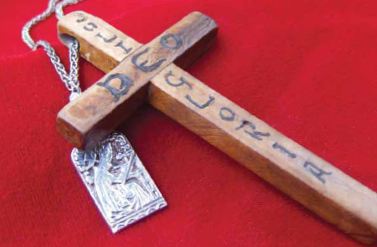
Faithful witnessing to life in the Gospel is hard. It is the hardest thing we do, moment-by-moment. Sometimes we’re great and sophisticated at it. Other times we get by and get through with barely a cliché or by the skin of our teeth, plunging into the darkness with the utterance of a single soli deo gloria.
As a community of brothers, we hold one another through affection, through the discipline of a Rule, through mentoring and sometimes good old fashioned cajoling to this witness to the ironic life we have received: an ironic life that can be a pain in our behinds when necessary, an ironic life that can be a joyous offering at other times, an ironic life that can be as dangerous as it is healing, as severe as it is gentle, as bewildering as it is meaningful. And what do we make of the ironies of this life rooted as it is in our baptism, in our vows, and in this fellowship?
A few years ago, before beginning this journey with the Brotherhood, I harbored a growing irritation with a colleague I worked with. Like the ironies of the religious life, she seemed to see success where I saw failure, was joyous in the midst of chaos while I was miserable, found organization stifling where it brought me some peace of mind. I asked a Zen priest about my irritation, and she reminded me to practice in those moments when my colleague was driving me the most crazy the old spiritual practice of breathing: inhaling light and exhaling darkness. Of casting out the poisons of fear and resentment and drawing in the light of Life.
The spiritual life of this body is much like that. This body breathes through the ironies: breathes out the darkness, offering it to a God who is the only One who can manage to fashion it into something creative and generative. This body breathes in the Light, taking in the Spirit left for us to enliven our steps and strengthen our hearts, hands, and minds for service in Christ’s name.
I don’t suppose many of us, if any of us, will be Olympians as a result. No, we will be so much more than that! The Olympics celebrate the strength and skill of the human body in its prime – a prime that lasts a tiny fraction of time, maybe only a second or two, especially in the grand life of this planet, let alone the cosmos. When we lift up our hands to receive the Body of Christ or throw the pall over a brother about to make vows for the rest of his natural life, we embrace the great dance of grace that transcends life, death, and even time itself. We wear a cross where an Olympic medal might hang, a hood for a crown, shading our eyes from the immeasurable glory that is God’s, covering our heads in the storm that is God’s gracious justice. We get our hands dirty planting our lives and the lives of others in the fertile earth and ever-flowing abundance of God’s love, that we might grow by grace into the sturdy, spiritually rooted ones Jeremiah envisions: so that clothes and food worry us less than abiding in the life of our Savior.
We show nakedness and vulnerability when the world demands decisive strength. We offer rugged solidarity where the world demands abandonment. We are brought together when the world flees to all corners. We are scattered when the world wants us pinned down in one place. Where the world proclaims difference, we call each other brother and clothe one another in sameness. Where the world wants to oppress with uniformity, we reflect an uncountable host of differing gifts.
We are a community of these and so many ironies for the simple reason that the life we proclaim is ironic: death leads to life, vulnerability to strength, darkness to light, failure to success, humility to a true pride in our God. And all is meant to breathe into being a kingdom – God’s kingdom: revealed yet hidden, beaten yet victorious, in here, yet out there . . . where we are called to serve.
Sermon for Easter Sunday
April 8th, 2012
Listen here.
Delivered at The Episcopal Church of Our Saviour, Mill Valley, California
Mark 16:1-8
I have a question for you: Why are you here?
Maybe there are as many answers to that question as there are people in the room. But I invite you to dwell on that question this Easter Day.
When I was growing up in the Midwest, I remember when I was six or seven years old piling into the car and driving thirty miles up the road to the Cathedral in Salina, Kansas. We were going to a one-man dramatic presentation of Mark, something a number of fine actors do around the country to this day.
I invite you this Easter to take a couple of hours, and read through the Gospel According to Mark in a single sitting. Mark is a fascinating gospel, and this day we heard the original ending to the book. It’s an ending which does not leave us with any grand proclamation or mission, but rather with the women fleeing with terror and amazement from the empty tomb. They are silent. They tell no one what they have seen.
At some point in the later first century or early second century, somebody came along and decided he didn’t like this ending to Mark, so he tacked on a new, little ending. Then again, another person or community came along a bit later and decided they didn’t like that ending, either, so they tacked on yet another longer one. For many years, when I would open my study bible, this original ending really bothered me, too. It didn’t sit well with me as I was searching in earnest for something more final, more definitive, more compelling to prove the Easter story.
But now, I have grown to like the original ending because it leaves us hanging. It leaves us with a question.
The beauty of Mark’s gospel is that it’s really pithy, short, and direct. In a way, you could say it could be titled “Jesus and the Three Stooges.” Jesus is out preaching, proclaiming, teaching, and healing, while the disciples are biffing and bopping one another and saying, “We don’t get it.” Mark understands that there is always another character in the story – perhaps the most important character of all (other than Jesus) – and that is Mark’s audience. He is always teasing us in a way, tickling us under our chins, contrasting our faith with that of the disciples’, our awareness of what this is all about in contrast with their comedic ignorance.*
What I most remember about the dramatic presentation of Mark at Christ Cathedral was the actor himself, a short man perhaps in his fifties, dressed in a simple tunic and pacing back and forth barefoot on the cold concrete of the chancel step, beads of sweat forming on his brow as he re-told the fast-paced narrative with a fiery passion. At the end of his telling I also distinctly remember a woman sitting nearby who said to someone sitting next to her in a pragmatic way that only a Kansan could, “Well! I’d be surprised if he didn’t catch pneumonia.”
Looking back on it now, I don’t think she quite got it.
But then, that’s the thing about Mark. Nobody in the gospel gets it. The women at the tomb don’t get it! We hear about them today approaching the tomb expecting to find a body, and thinking about very practical things, like how they might roll away the stone sealing the entrance to the tomb. They, like us, think they know how life should be, just as we think we know how life should be: We are born, we live what we hope is a decent life, and then we die. We spend a huge amount of energy building institutions, financial plans, and societal structures around this assumption, this assumption of the linear model of being human: birth, life, death (and maybe we end up with a plaque someplace with our name on it.)
The women were going to embalm the body of their Lord and Savior. They have walked with Jesus through his passion. In some ways, they have been more faithful than the apostles, who all betrayed Jesus and fled during his trial and execution. Who knows where they are? Sleeping in on a Sunday morning? Hiding out someplace out of fear? But the three women are at the tomb, and they are startled to be greeted by an open tomb and a figure inside who says, “He is not here.” In a way, he is asking the women, “Why are you here? Why are you looking for Jesus amongst the dead?”
These days in the secular press, it’s very clear in black-and-white that the Church is dying, along with so many other institutions in the West that are floundering. If you read only a little more deeply, you can easily reach the conclusion that there are ecclesiastical authorities who are more than happy, it seems, to help the Church die.
Why are you here? Have you come to look for Jesus amongst the dead? Have you come to a dying institution for sentimental reasons, for family reasons, or for the Easter Egg hunt?
Why are you here? Mark poses these questions to us in today’s Easter gospel. What are you looking for?
He is not here!
Jesus has gone out ahead. He is risen! He is not stuck here within these walls simply for you to come by and get your “Jesus fix.” What we’re about to do is give you a small portion of bread and share a common cup to remind you that Jesus is risen, but not to tell you that Jesus is stuck up here on the altar. Rather, we share in communion to remind one another that he is risen in our hearts and he is risen in the world out there, waiting to greet us where we are called to serve, just as he was waiting to greet his followers in Galilee!
I challenge you this Eastertide not to come to church simply to find Jesus here, but to look for Jesus out there: the work and the life of the Risen Christ waiting to meet and greet you in acts of mercy, justice, and compassion; defying death; confronting the world’s linear notion of life. Our life is not linear. Nor is it cyclic or karmic. It is instead what one of my spiritual directors calls the spiritual life of the spiral: the spiral upwards towards God’s heart. And that spiral driven more by questions than answers is an eternal journey that binds together all of the human family: living, dead, and yet to come in the Risen Life of our Lord and Savior.
And this Easter life is not what you’d expect. You will be amazed, you will be frightened, you will be inspired, and you will be devastated.
But you will be given new life.
For this is how we live, and how are called to be as an Easter People.
_______
*I owe this perspective in large part to The Rev. Dr. Katherine Grieb, Professor of New Testament at Virginia Theological School, and a retreat she led on Mark with the Brotherhood of St. Gregory in January, 2011.
A sermon delivered on
the Feast Day of Adelaide Case
July 19th, 2011
at the Summer Convocation of
the Brotherhood of Saint Gregory
Mt. Alvernia Retreat Center
Wappingers Falls, New York
by Richard E. Helmer, p/BSG