Friday, June 14, 2013

Tohoku, Tokyo, and Kansai Reflections

“Let beauty awake for beauty’s sake.”

– from Robert Louis Stevenson’s Songs of Travel

Azaleas bloom placidly in the midst of urban frenzy outside the Ichihara’s home near Rikkyo University in Ikebukuro, a suburb of Tokyo.

Sashimi presented as part of a beautiful dinner at a restaurant in Sendai, hosted by the Bishop of Tohoku.


With The Rt. Rev. John Hiromichi Kato, Bishop of Tohoku, The Rev. Shintaro David Ichihara, and Goh Saito, a student and acolyte from Rikkyo University. Bishop Kato attended CDSP while I was in my first year there, so the evening was a welcome reunion of sorts!

Mugiho Ichihara and Daniel compare their ABC’s and hiragana in Ikebukuro.

Korakuen Garden (後楽園), considered one of the great three in Japan, offers a famous example of “borrowed scenery.” Okayama-jo (岡山城) Castle is actually on the other side of the river from Korakuen, but here is integrated fully into the garden’s many perspectives.


A chikurin (竹林 – bamboo thicket) in Korakuen.


Okayama-jo Castle, the “Crow’s Castle”, looks forbidding over the Asahi-gawa River.

Central Okayama (岡山市) includes scattered bronze statues of small children, infants with their mothers, wildlife, and this combination near Okayama Station. The hato (鳩), pigeons, add their own life to the art.

The rooftops of Miyajima (宮島), a picturesque island off the Sanyo Coast near Hiroshima. It includes some of the most beautiful shrines and scenery in the whole country.

The great gate or torii (鳥居) at Itsukushima Shrine (厳島神社), Miyajima. At low tide, people can walk out to the gate. The shrine is accompanied by a beautiful pagoda and numerous other striking examples of classic Japanese architecture. Every other step offers a picture postcard view.


Todaiji (東大寺) Temple, Nara, is among the great ancient Buddhist sites of Japan, and one of the largest wooden structures in the world.


Accompanying the huge, ancient Buddha Vairocana is an eighteenth-century bosatsu (菩薩 – bodhisattva). Crowds of tourists and children attempt to grasp the wonder of this site.

St. Agnes, Kyoto.

The altar at Christ Church (Pro) Cathedral, Sendai.


Contemplations

“Since I learned how to enter the forest of meditation, I have received sweet dewlike drops from that forest. I have found that the door to meditation is open everywhere and at any time, at midnight, or at noonday, at dawn or at dusk. Everywhere, on the street, on the trolley, on the train, in the waiting room, or in the prison cell, I am given a resting place of meditation, wherein I can meditate to my heart’s content on the almighty God who abides in my heart.” – Toyohiko Kagawa

Journeys with my son, Daniel, this past week, have given us further glimpses into the ministry of the Nippon Sei Ko Kai in Japan, and the heart of what might be regarded as Japanese spirituality. The Japanese people have often said of themselves that they are “born Shinto, marry as Christians, and die Buddhists,” a reference to the eclectic spiritual journey many in this culture follow. And it is true. Bearing witness to this reality are the ubiquitous shrines and Shinto holy places, the Christian wedding chapels more common than congregational gathering places, and the countless Buddhist cemeteries that dot the countryside and cities. Less than 1% of the population is formally baptized into Christianity, and of that, only a fraction are Anglicans. Yet the mystical connection with the incarnation everywhere in Japan is so hard for me to miss, even if very few here would describe their relationship with the earth and neighbor using that distinctly Christian theological language.

Christ Church Cathedral, Sendai, has now been razed due to earthquake damage. The congregation and diocesan offices are temporarily housed in rented space a few blocks away until a new cathedral is built.
On Sunday, at Christ Church Cathedral in Sendai, I had the privilege of speaking briefly to the church women who gathered for one of their regular lunch meetings. Christ Church Cathedral currently meets in a rented space – the original Cathedral and its affiliated diocesan offices were too badly damaged in the March, 2011, earthquake to be repaired. (Shintaro Ichihara and I gently argued over whether the rental space could be deemed a Pro Cathedral...) So now, the cathedra is tucked neatly into the corner of a room that would more likely be filled with filing cabinets, work stations, and cubicles. Each Sunday, the devoted members of the community pack into the room for prayers and eucharist, singing hymns to the accompaniment of an old, revered Yamaha pump organ, and then efficiently rearranging folding tables and stacking chairs for subsequent meetings.

The Rev. Shintaro David Ichihara and I are given a warm welcome on Sunday at Christ Church (Pro) Cathedral.

Nozomi Matsumura, Shintaro Ichihara, Daniel, and Katie Young pause for a shashin following Eucharist with the Christ Church community. Nozomi and Katie contemplate their next adventure as their internships with the Issho ni Arukou Project of the NSKK end later this month, and the project itself undergoes a metamorphosis as it returns primarily to diocesan oversight.


I spoke on Sunday of being moved deeply by my brief visit to the Diocese of Tohoku, and witnessing the recovery efforts of the Issho ni Arukou Project, but most especially by our visit to Okawa, Ishinimaki , where so many children lost their lives to the tsunami. The Buddhist altar and commemoration outside the gutted school, surrounded with so many Jizo, reminded me that contemplation and meditation provide the only path to grasp the reality of such tragedy. And contemplation is at the heart of the Christian path as much as any other. What else are we really doing when we accept a morsel of bread and regard it as kirisuto no karada (Christ’s body) and share in a common cup and call the wine kirisuto no chi (Christ’s blood)? The sacramental life is profoundly meditative, incarnational, and bound to draw us into the seeming contradictions of death and life, tragedy and joy, the spiritual and the embodied. The courage, witness, and perseverance of the members of Christ Church Cathedral and many in the Diocese of Tohoku is a testament to their commitment to this sacramental life, lived out in a world that often may perceive their Christian vocation as strange, and yet through Issho ni arukou, they have become friends to so many struggling to move beyond unimaginable loss.

The interior of St. Agnes Cathedral, Kyoto.

With The Rev. John Masato Yoshida, Dean of Bishop Williams Seminary, Kyoto, in the seminary chapel. 11 seminarians reside on campus in a three-year program preparing them for ordained ministry. Daniel was very generous with his Japanese skills, helping with translation during our visit.


Taking full advantage of our Japan Rail passes, Daniel and I have journeyed around the Western part of Japan since departing Tokyo on Monday. We had the honor of visiting the historic Cathedral Church of St. Agnes, Kyoto, and the Bishop Williams seminary just a block away, where the Dean, The Rev. John Masato Yoshida – who also chairs the Standing Liturgical Commission of the Nippon Sei Ko Kai – took time out of his busy schedule to introduce us to one of the NSKK’s two centers for theological education.

That same day, we had journeyed to Nara, the earliest capital of Japan, where in the eighth century, the Emperor Shimyo had commissioned a massive bronze image of the Buddha Vairocana. The casting of this huge work began when Charlemagne was only ten years old , the Gregorian mission to Canterbury under Augustine was barely older than the parish I now serve in the United States, and all of Christian Europe was starting its long journey through the Middle Ages. Keeping that ancient historical parallel in mind added only the magnificence of this contemplative statue that epitomizes emptiness in meditation. Moreso for me was the mental image of Buddhist monks standing together in the statues upturned hand. Our guidebook mentioned that four or five might be seen there together during the statue’s occasional cleaning. 

It’s hard to capture the grandeur of the Buddha Vairocana statue in 東大寺 (Todai-ji Temple), Nara. Imagine four monks standing in the upturned hand, and you start to get the idea. This famous site, housed in one of the largest wooden structures in the world, was overflowing with school children visiting from all over central Japan.
It reminded me of the way Japan sits in all of its vitality in the hand of the divine that we call God, holding together enormous contradictions in contemplation: building, rebuilding, preserving, and constantly reinventing on land that can move at any moment; at the edge of the sea that can overpower even the cleverest of human endeavors at any time.

In the West, we often work hard to resolve contradictions, and too often pursue a false consistency that relies on more denial of reality than anything else. We can gloss over life’s inconsistencies and race ahead in the pursuit of an unrealized future we never reach. We can fill our hearts with the gruel of self-righteous “productivity” while neglecting the cries of needful souls around us. All the while, we miss the power of the present moment – no matter where we are – and what God offers us there. Our Christian sisters and brothers in Japan, drawing on not only the lessons of being minority missionaries amongst their own people, but on the deep heritage of their culture, remind us that contemplation – meditation – is one of the great teachings of the sacramental life, and through this most intimate kind of self-emptying prayer, we connect in the holy present as Jesus did and the saints have done for millennia. 

We then can allow the infinite mercy of God’s grace to connect to us, that only resource that can help us serve in the face of any tragedy and overcome all challenges as part of the Body of Christ, living beyond death.


Sunday, June 09, 2013

Let Them Live Again

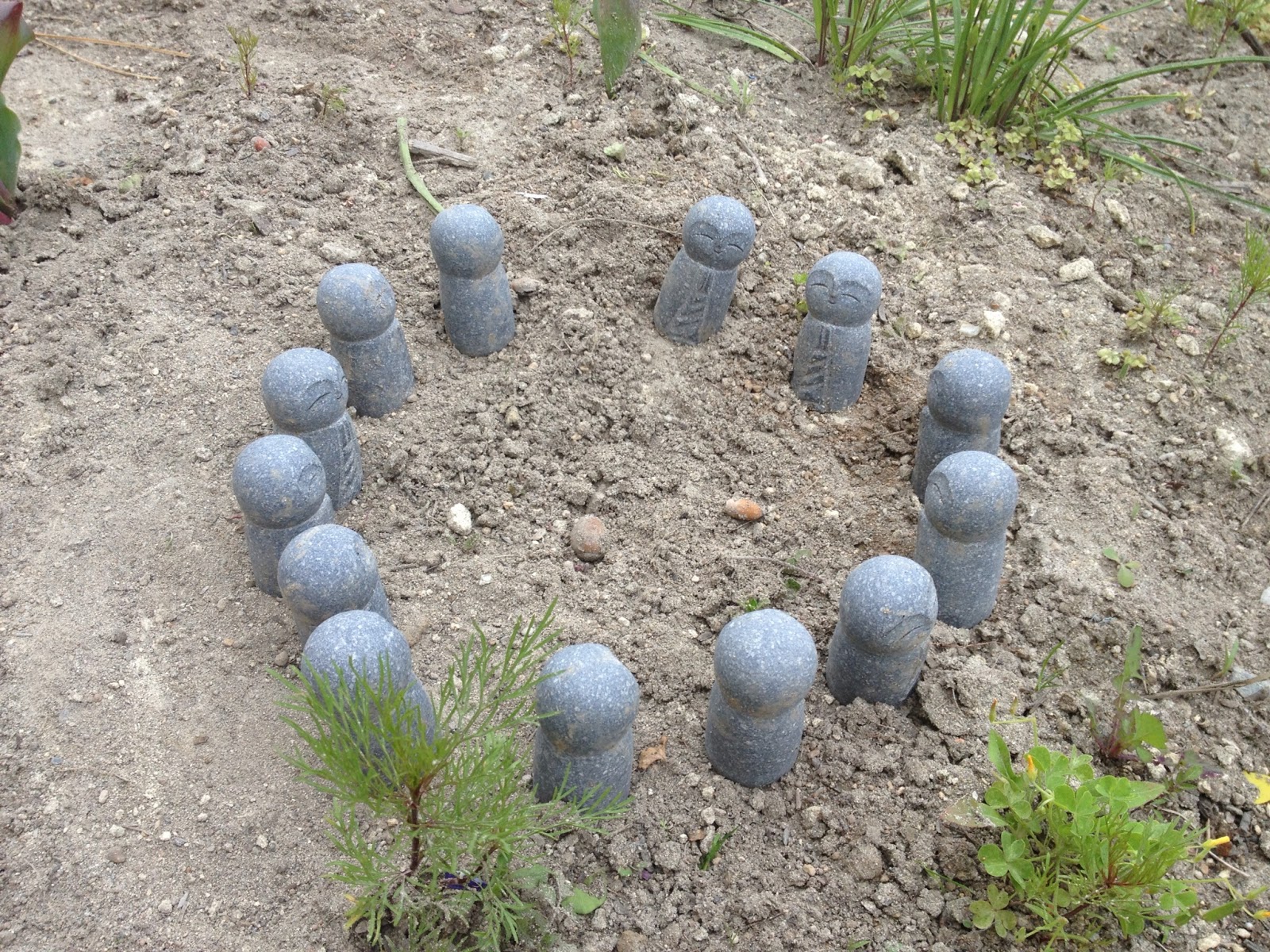
At the original Fuji Kindergarten, Yamamoto,  Jizo – statues of spiritual beings believed in Buddhism to shepherd the souls of deceased children, protect the living, guard travelers, and reside at the thin places between life and death – are placed in a circle in the memorial garden to honor the students who died there and the teacher who gave her life to save many others in the March 11th, 2011, tsunami.

A sermon delivered at Christ Church Cathedral, Sendai

by The Rev. Shintaro David Ichihara

trans. ed. The Rev. Br. Richard Edward Helmer

The Third Sunday after Pentecost

For the past few weeks, I have struggled with what it would mean to preach in Sendai, since both the Gospel and Old Testament readings today are stories of dead sons being restored to life.

This weekend, Richard and Daniel Helmer and I visited several parts of the Diocese of Tohoku. It was a first visit for Richard and Daniel to these tsunami-devastated areas; I had seen them before. Nevertheless, Okawa Primary School still had me at a loss for words. All that I could offer was Elijah’s prayer: “O Lord my God, let this child’s life come into him again.” And, of course, this is the cry of parents who lost their children to the tsunami. It is profoundly difficult for me to preach about this from the pulpit, thinking of the reality that these families must continue to face.

One commonality found in the two stories we hear today is that the dead in each instance is the only son of the family, and he is survived only by his widowed mother. This means the widows faced a very difficult future. In their societies, a woman could not live without a patron, whether it was her father, her husband, or her son. Lacking all of them, the widows’ plight in these stories was without hope.

Elijah and Jesus both fought with this reality, and yet we know in our earthly pilgrimage that the sons of widows and countless innocents will not be raised today from the dead. The harsh reality is that the families of the victims of the tsunami remain in deep sorrow and pain, and they may never find full healing. So how, then, does today’s word speak to us?

A few weeks ago, Genji Yamaura, a Roman Catholic doctor who translated the four gospels into the Kesen Japanese dialect (spoken in the area of Ofunato) delivered a special lecture at Rikkyo University, where I serve as a chaplain. During the lecture, he invited questions from the audience. One question was, “Why do so many innocents have to experience such hardship? What do you think?”

Mr. Yamaura replied that after the earthquake and tsunami, he reached a simple conclusion: every human being dies. Regardless of the cause of death – whether tsunami, earthquake, or cirrhosis of the liver – everyone must face death. The implication of the question itself is that good people should not die, while bad people should. As you know from experience, this is nonsense. Jesus himself said that natural disaster is not a punishment from heaven. Even if people have to endure great hardships wrought by disaster, it does not mean they are making recompense for some kind of sin. God created the world so that everything on Earth might enjoy life. We are ultimately God’s instruments. Our only task is to attend to the world’s reality while listening to God with a pure mind and await the enlightenment God promises to give us. This is our most important task in life, even as we face the fact of our ultimate demise in the future.

Elijah did not have the power to compete with the desperate power of death on his own. He could only ask for God’s power to restore the boy’s life. Jesus happens upon a group of people in a funeral procession, and he has compassion for the boy’s mother. As many of you know, the words “have compassion for” implies a visceral response: a feeling in one’s abdominal organs. In the Gospel of Luke, “compassion” regularly appears with the words “see” and “approach.” The deeply seated reaction of compassion is what compels Jesus’ actions; compassion is what brings the dead son back to life.

After visiting Shinchi, Richard and I talked about the gospel for today. We had just heard the tragic story of Fuji Kindergarten and wondered how it intersected with the story of the widow’s son being brought back to life. Richard suggested that the regained life was a communal life. Not just the restoration of an individual’s physical life, it is much more: it is restoration of life in community.

Even though we all pray for return of life to the dead, we struggle with our lack of power to make it happen. Moreover, we all face a destiny of death someday, for which there may be no explanation. Yet isn’t it possible for us to see the reality of both life and death, to approach them – using the words of Luke – and to find in that approach the compassion to help recover the people lost in sorrow? While we do not even have the power to heal sorrow, we do have the power to help restore their life in community. In this sense, the focus of regained life is not just for the sons, but also for their mothers.

We are approaching an important milestone of the Issho ni Arukou Project. At this time, I feel we are called to listen to the word of God, who brings hope that everyone in such deep pain and sorrow may be restored to the fullness of life in community. Regardless of what happens next with the Project, we Christians are called to lead our lives after the example of Jesus, who sees, approaches, and has compassion; who says, “Do not weep anymore.” 

This might indeed be the special calling at this time for the people of the Diocese of Tohoku.


Saturday, June 08, 2013

When Words Fail

Katie Young, Shintaro Ichihara, and Nozomi Matsumura discuss the day’s plans.
As if yesterday’s visit to Shinchi were only a warm up, today our host, The Rev. Shintaro Ichihara, gathered us with two interns in the Issho ni Arukou Project: Nozomi Matsumura and Katie Young of The Episcopal Church’s Young Adult Service Corps. Their experience helped me greatly widen my understanding of the scope of Issho ni Arukou. Far more than just providing community relief efforts for natural disaster, the program has been helping support and provide community for immigrants married or moved into Japanese society and their children, ranging from English skills to tutoring to vocational development throughout the Tohoku diocese and region.

Katie and Nozomi’s guidance helped us also widen our vision of the scope of the earthquake and tsunami disaster. Nozomi furnished us with a finely detailed road atlas that showed – page after page – the reach of the tsunami devastation in each coastal city and town along the northeast coast, along with more aerial before-and-after pictures. And so the five of us drove north together from Sendai to Ishinomaki, a port city originally founded upon the rice trade. Driving along the coastline, we stopped to behold the tsunami’s intractable legacy on an urban setting. From burned out cars to the husks of houses where no next of kin can determine property disposition, the destruction of the tsunami remained prominent well beyond two years since the ocean first breached the sea wall. A hospital where many died was slowly being demolished. The shell of a huge school stood as testimony to the horror of young lives vanquished suddenly by an onslaught of cars and debris piled up and driven inland by the raging waves. There was no protection then from the ensuing conflagration as all that fuel gathered together and caught fire. Many subsequently perished from a blaze in the midst of water.

Most of central Ishinomaki was damaged or destroyed, and 3,000 people died there. The search for bodies continues to this day even as the city struggles to rebuild. All around are signs that read “Ganbarou Ishinomaki!” – Let’s work hard, Ishinomaki! – an appeal to the stubborn determination in the face of epic tragedy – a determination that forms the backbone of a people’s renowned resilience.

But what utterly silenced me was the journey a bit further north and east to the site of Okawa, a little agricultural village-suburb at the end of a lovely long valley of rice fields nestled between rolling, green mountains. On the way, we passed by miles and miles of trucks and workers rebuilding a massive levee system along the idyllic river and estuary. Okawa sits at the mouth to the ocean, right at sea level. Or I should write there it sat. All that is left of this community is the remnants of Okawa elementary school, a sarcophagus of terrifying proportions – an open entombment of memories of the 74 children and 10 teachers who perished there when indecision left the school’s children in the direct path of the raging waters at the foot of a steep mountainside. Shintaro told me just one teacher survived and has not been able to speak since. Only 30 pupils of the school lived to recount the event. Okawa has now all but disappeared into the ocean as the land mass of Ishinomaki descended during the earthquake by as much as a meter or more in some places. The school itself is like a huge relict or architectural headstone for the little town reclaimed by the sea forever and families broken irreperably by unspeakable tragedy. They still come and leave flowers and offerings and illumine the ruins by night.

It’s impossible to capture the heartfelt emptiness the shell of Okawa elementary school evokes. The scene screams for silence and challenges every possible path of explanation or comprehension. No wonder people come and go all day, reflecting on the tragedy that it represents, making pilgrimage perhaps not only to this shrine for the dead, but into the frightening depths of their own misgivings. But, then, that’s what thin places are for: to open us up to our own fears not about what might be, but what is, and come to grips with reality unfiltered by our denial or dreaming.
Outside the broken and twisted remains of the school are images of the Buddha along with a brand new memorial for the remembered dead and a statue of an angel looking skyward as a sign of hope. Okawa reminded me of the wounds of Christ: Christ on the cross, Christ in the tomb, Christ risen from the dead: “Christ has died, Christ is risen, Christ will come again,” that eucharistic enigma of contradictions at the spiritual foundation of our tradition. Okawa is the epitome of these contradictions that only silence can begin to comprehend. Wordy prayers give way to contemplation holding together the ironies of life and death, human ingenuity and insurmountable natural forces, fateful decisions made or not made by the well-intentioned, the simultaneous fallibility and heroism of leadership, the towering arrogance of the ego and humbling reality of suffering, the wide-eyed lively innocence of children in the face of certain death. . . Okawa elementary seems almost frozen in time, its wreckage capturing a moment that circumscribes our true nature in humility, that shatters our pretensions before our Creator; a thin place where our faith is not measured any more in ideas, theologies, or words, but rather only in watchful, contemplative silence. 

Dutifully cultivated flowers mark the perimeter of the school gutted by a fire that followed the tsunami’s destruction in Ishinomaki. Surrounding the school is a wasteland of debris and bare foundations. On one foundation sat an elderly man in silence next to a child’s bicycle while we were there. Whether it belonged to his deceased grandchild or was a simple memorial to the children who died there, we could’t tell nor ask.
A constantly tended Buddhist altar and memorial markers adorn the entrance to the Okawa elementary school grounds.


Friday, June 07, 2013

Issho ni Arukou

A solitary utility pole stands almost as a monument to the massive disaster amongst the rubble of the old sea wall. Off in the distance, a new levee system is being erected. The new levees, mandated to be 7 meters high, are in themselves an ironic testimony to nature’s ultimate upper hand: the tsunami rose to a terrifying 19 meters in some places.
Reflecting on our trip today to Shinchi, a small fishing and agricultural community on the coast south of Sendai, brings me to a series of fateful declarative statements that might read like newspaper headlines. The March 11, 2011, earthquake and tsunami killed 116 of Shinchi’s 8,000 residents. Entire neighborhoods were washed away. Fishermen lost their livelihoods in a matter of seconds, farmers forever their fields. Concrete bridges were carried hundreds of meters, flipped over, and laid to rest where children once slept. For the fishermen who wisely took their boats out to sea to protect them, their shrewdness was rewarded only with the Fukushima Daichi nuclear disaster, which contaminated and collapsed the local fishing industry indefinitely. A boat not fishing is as good as no boat at all. Farmers face fields not only poisoned by sea salt, debris, and sand from the tsunami, but potentially too radioactive to plant. If this together isn’t sobering enough, Shinchi is only one example – a tiny snapshot even – of the devastation that consumed hundreds of square miles of agricultural land, homes, and even entire towns and villages along the coast of the Fukushima and Miyagi Prefectures.

St. John’s collapsed during its demolition, roof to foundation. Too heavily damaged in the quake to be salvaged, it still provided emergency shelter for 13 residents of the neighborhood in the cold aftermath of the tsunami. It soon became a pilgrimage site for the whole of the Anglican Communion to remember the terrible disaster that befell so many.
The local Nippon Sei Ko Kai parish of St. John’s, Isoyama, was damaged beyond repair. Less than a kilometer away, two parishioners died when the tsunami descended from over the small coastal mountain behind their traditional Japanese inn, leaving only the barest of foundations in its wake. At the same time, their daughter, also a member of St. John’s, was desperately laboring to keep her kindergarten students above the rising waters in Yamamoto-cho to the north as their bus was caught in the onslaught. First, they climbed onto the roof of the bus, then onto the second story of their school. When all was over, 7 of the 50 children had drowned, and 4 would later succumb to hypothermia along with their teacher, Junko-sensei, who had given everything so that as many precious lives as possible would survive.

Hiroshi Matsumoto, our guide today, showed us up the little mountain to the shrine where residents of Shinchi fled and watched their livelihoods and homes disappear into the sea. The water rose almost literally to their feet before it receded.

Daniel feeds chickens kept for their eggs by volunteers and local residents at the Issho ni Arukou Project Center.

The Church, with funding from across the Anglican Communion, including aid from Episcopal Relief and Development, responded to the disaster with the Issho ni Arukou Project, setting up temporary shelters as a volunteer center in a little cluster at the edge of the tsunami destruction zone. With staff-in-residence, they offered community to the lost and destitute while governmental agencies began to lead the cleanup and build temporary housing. Even after recovering shelter and basic necessities, residents of Shinchi returned to Issho ni Arukou to raise chickens for eggs and make handcrafts to sell for community relief and rebuilding efforts: anything to feel productive for the community as a whole while the individual livelihoods of many remained uncertain.
A local artist offered his studio for Sunday worship to St. John’s, Isoyama. They are ultimately planning to rebuild on the site of the old church building, providing not only a new sanctuary for Christians, but a coffee shop, memorial garden, and community center for all of Shinchi. Stained glass from the original building has been stored away nearby to await its new home. The rice fields that St. John’s once overviewed will ultimately become part solar farm, part recreational area. Residents are rebuilding now on higher ground while dozens of workers erect a whole new levee system for the next time the sea and the earth shift. Meanwhile, rice field by rice field is reclaimed with the painstaking removal of contamination and the importation of new topsoil.
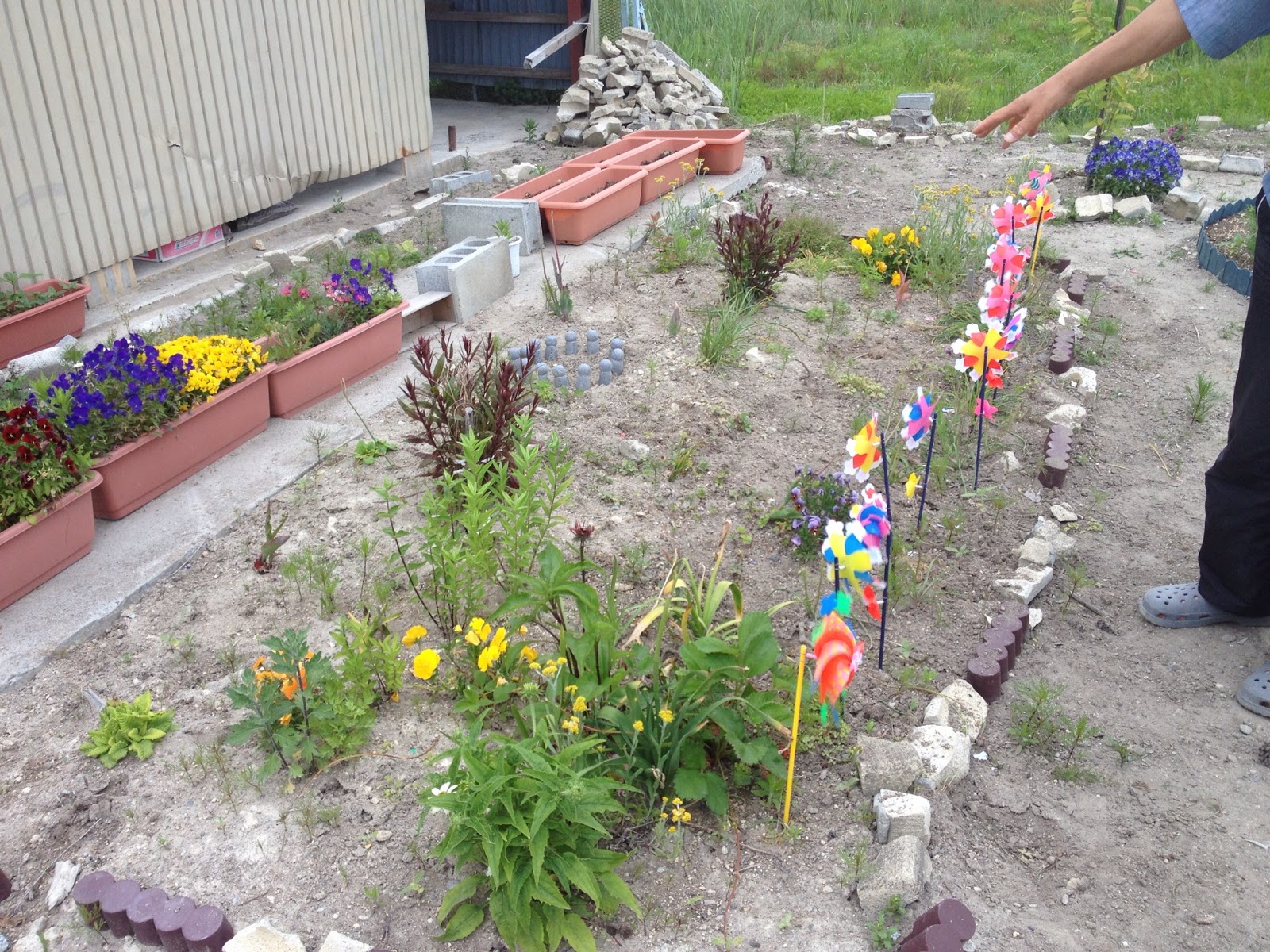
Pinwheels bear witness to the dead in a little memorial garden at the original Fuji Kindergarten site.
And Junko-sensei’s devotion seems to have crossed the boundary from death into new life. When the community weighed whether or not Fuji Kindergarten should continue on as an organization, people said they felt guided by Junko’s witness to give the sake of the surviving children highest priority. Fuji Kindergarten now gathers in a new building while the original building is kept as a memorial for tender, brave souls, still scarred by a death-dealing, imagination defying natural disaster. The entrance is now ordained with thousands of paper cranes, a visitor book, and flowers. A small memorial garden, tended each day by the principal, includes 13 pinwheels for the 11 children who died in the tsunami, Junko-sensei, and a student who died in a car accident a year after the quake. Junko-sensei’s husband was baptized three months after her death, and their four children carry the family legacy forward in faith.

On the way back to Sendai, Shintaro and I discussed the uncomfortable implications of preaching on Sunday’s readings in the context of such devastation. How could we preach on the raising up of the sons of the widows of Zarapheth and Nain when children known and loved today will not rise again in this life? Maybe the response of the Body of Christ to the Japan earthquake and tsunami provides at least a partial answer. The restoration of the sons of the widows restored their mothers to life in community, ensuring them connection and hope for the future. The Church in Shinchi and throughout Tohoku has been doing precisely that — restoring one person, one family at a time to community and hope for the future with the Issho ni Arukou Project:

It simply means “Let us walk together.”

Matsumoto-san shows the water line in a storage shed on the original Fuji Kindergarten property. Almost two-thirds of the student body were picked up by their parents between the earthquake and the arrival of the tsunami. The remainder were loaded into buses, but couldn’t pull away from the school before the water struck.
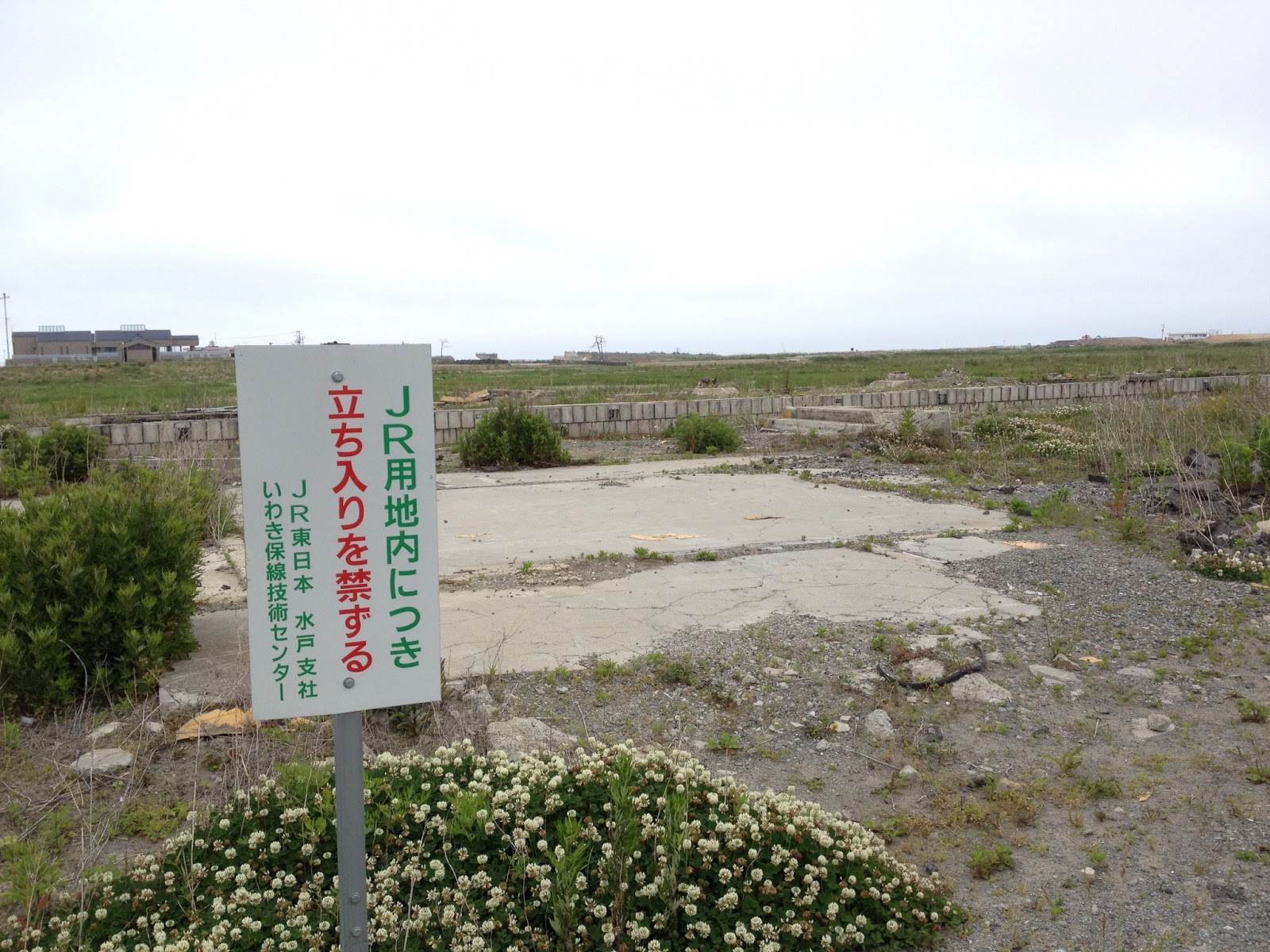
The remains of the Shinchi Japan Rail Station are marked only by a foundation and a no trespassing sign. The tsunami ripped up the rails, littered the landscape with train cars, and demolished the wooden terminal. A more robustly built water treatment plant in the background survived.
The view from the shrine overlooking the residential neighborhood wiped out by the tsunami. Residents who fled here watched the water reach almost to their feet before it receded.
Foundations are all that remain in this residential neighborhood. The concrete slab in the center of the photo is not a foundation, but a bridge that was lifted, flipped, and carried nearly a hundred meters from its crossing over a canal to the wharf.
With volunteers and residential staff of the Issho ni Arukou Project in Shinchi.
Our host, The Rev. Shintaro David Ichihara (L) and Daniel look on while Hiroshi Matsumoto shows before and after aerial pictures of Shinchi.